

Opening the Black Box of Digital Hardware: Why Environmental Assessments Fall Short
Anish Koyamparambath
Information and communication technologies (ICT) form the technological backbone of contemporary digital societies. The term ICT generally refers to the systems, devices, and infrastructures that enable the processing, storage, and transmission of information, including computers, servers, communication networks, and a wide range of electronic equipment used across industry, services, and daily life.
Over the past decades, the rapid expansion of digital services, cloud computing, and connected devices has significantly increased the production and deployment of such technologies worldwide. This expansion has been particularly driven by the growth of data centres, which process and store vast amounts of digital information and now support connectivity for a majority of the global population.
At the same time, the speed and scale of this technological development have far exceeded the evolution of supporting systems such as recycling infrastructure and material recovery, creating increasing environmental pressure across the life cycle of electronic equipment.
Where do environmental impacts really come from?
The environmental footprint of ICT devices arises largely from the energy required both to manufacture them and to operate them throughout their lifetime. This is particularly visible in infrastructure such as data centres, which alone account for a measurable share of global electricity consumption and associated emissions due to continuous operation and cooling requirements.
Extraction of rare metals and critical raw materials
Beyond energy use, the extraction of rare and critical metals required for device production and the management of electronic waste also contribute substantially to the sector’s total greenhouse gas emissions.
Historically, many assessments have concentrated on the electricity consumed during device operation while paying less attention to emissions generated during the manufacturing of key components such as semiconductors, batteries, and display technologies.
The results of Life Cycle Assessment (LCA) studies can vary significantly depending on methodological choices, assumptions about extraction and manufacturing processes, and how researchers define the completeness of the available data.
Waste electrical and electronic equipment (WEEE): a complex composition
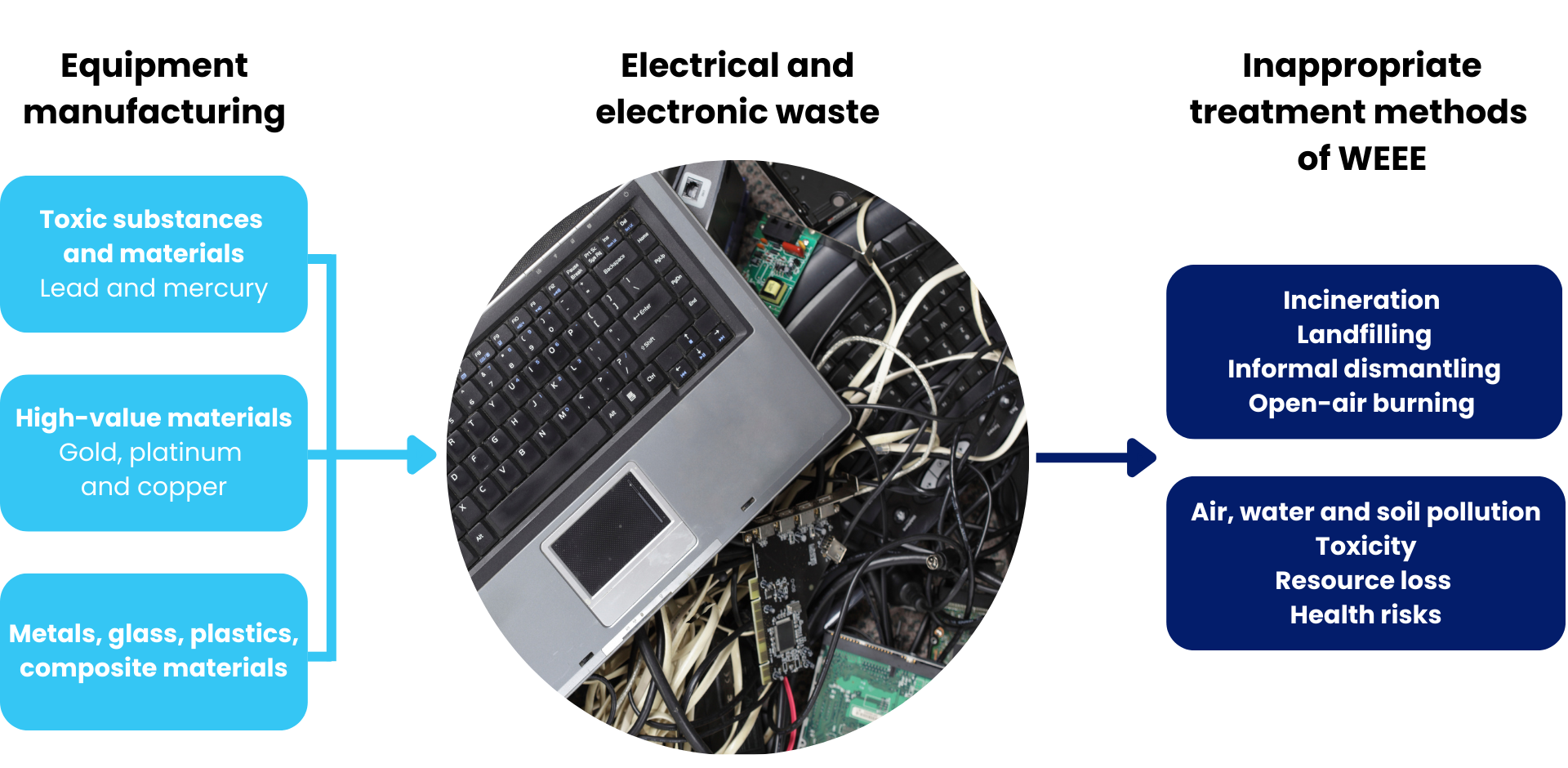
Limitations of life cycle assessments (LCA) in electronics
The environmental impacts associated with ICT products vary greatly from one study to another, particularly because the impacts of electronic components are not consistently represented in the available databases. les impacts des composants électroniques ne sont pas représentés de manière cohérente dans les bases de données disponibles.
Current Life Cycle Inventory (LCI) datasets for electronics rely on fragmented and poorly harmonised information sources. Most of the environmental data currently used for digital technologies still originates from a foundational study in 2009.
Many later studies extend this dataset mathematically rather than updating the empirical evidence. As a consequence, environmental results for ICT products may appear precise while still containing large uncertainty, particularly when examined at the level of individual components.
A lack of data on electronic components
This limitation becomes more significant because modern electronics consist of complex assemblies made from numerous materials and highly specialised production processes, meaning that the real challenge often lies deeper in the material and manufacturing layers of electronics production.
This reinforces the need to update life cycle inventory datasets for electronic components so that environmental assessments better reflect current technologies.
How reverse engineering allows the measurement of electronic materials ?
One direct way to address the lack of detailed inventory data is to physically deconstruct electronic components and characterise their material composition through laboratory analysis.
Within the CEDaCI project, this approach was applied to data centre equipment by systematically dismantling components such as hard disk drives into distinct sub-streams (e.g., chassis, disk, permanent magnet, printed circuit board, and motor), followed by mass quantification of each fraction.

Subsequent preparation steps, including pyrolysis to remove polymers, mechanical size reduction, and acid digestion, enabled elemental analysis using Inductively Coupled Plasma Optical Emission Spectrometry (ICP-OES).
This workflow allows the reconstruction of detailed material compositions for components that are otherwise treated as aggregated “black boxes” in conventional LCI datasets.
Crucially, it improves material quantification within LCI by replacing generic or proxy-based assumptions with measured mass fractions and elemental concentrations, thereby increasing the granularity, accuracy, and transparency of inventory data at the component level.
By linking these empirical measurements with inventory modelling, the approach provides a pathway to generate more reliable and component-specific datasets, which are essential for improving the accuracy and relevance of environmental assessments of ICT products.


A French project funded by ADEME, in which WeLOOP is a partner, builds directly on the experience developed within CEDaCI. It extends the same analytical framework to a broader range of ICT components, including silicon wafers and their derivatives, hard disk drives, screens, electronic boards, and optical sensors.
The project carries out a systematic review of manufacturing processes and technologies, where process parameters are translated into parameterised life cycle inventory datasets.
Within this framework, WeLOOP contributes by supporting the project and collaborating with TND, as in the CEDaCI project, to generate accurate material composition data across different products within the same component family. These empirically derived material compositions are then integrated into the parameterised life cycle inventory models developed within the project.
From reporting to digital product passports
Improving LCI quality has direct implications for sustainability reporting, regulatory compliance, and product development.
Accurate and detailed material inventories enable more robust LCA, supporting environmental reporting frameworks and corporate sustainability strategies while also informing ecodesign decisions.
This is particularly relevant in the context of emerging European regulations such as the Ecodesign for Sustainable Products Regulation, where tools like Digital Product Passports require transparent and reliable product-level environmental data across the value chain.
A precise quantification of materials also makes it possible to more clearly identify environmental “hotspots”, particularly those related to critical raw materials, by analyzing their distribution and contribution within components and processes.
Such granularity allows stakeholders to prioritise interventions in design, sourcing, and end-of-life strategies. As regulatory and industrial demands for traceability increase, improving LCI through more precise and empirically grounded data becomes essential for enabling consistent, comparable, and decision-relevant environmental assessments of ICT products.
Permettre l’écoconception grâce à de meilleurs inventaires
Beyond reporting, improving life cycle inventories directly supports eco-design by enabling a more precise identification of impacts within electronic products.
Current datasets, often outdated and aggregated, limit the ability to distinguish impacts at the component and material level, leading to design decisions based on approximation rather than evidence.
Updated and granular LCI data allows designers to evaluate the effects of material choices, manufacturing processes, and component configurations, making it possible to prioritise strategies such as reducing critical raw materials, improving recyclability, and lowering manufacturing impacts.
By integrating empirical material characterisation with inventory modelling, LCA shifts from a static assessment tool to a practical design instrument, supporting circular design approaches and aligning product development with emerging requirements such as digital product passports.