


LCA – Life Cycle Assessment: complete guide
Life Cycle Assessment (LCA) is now an essential tool for understanding, reducing, and enhancing the environmental impact of your products. It helps identify the most impactful stages, guide your decisions in a concrete way, and meet the new regulatory and environmental expectations of the market.
WeLOOP supports you in your LCA initiatives with reliable analyses tailored to your challenges and directly applicable to your projects..










What is a Life Cycle Assessment (LCA)?
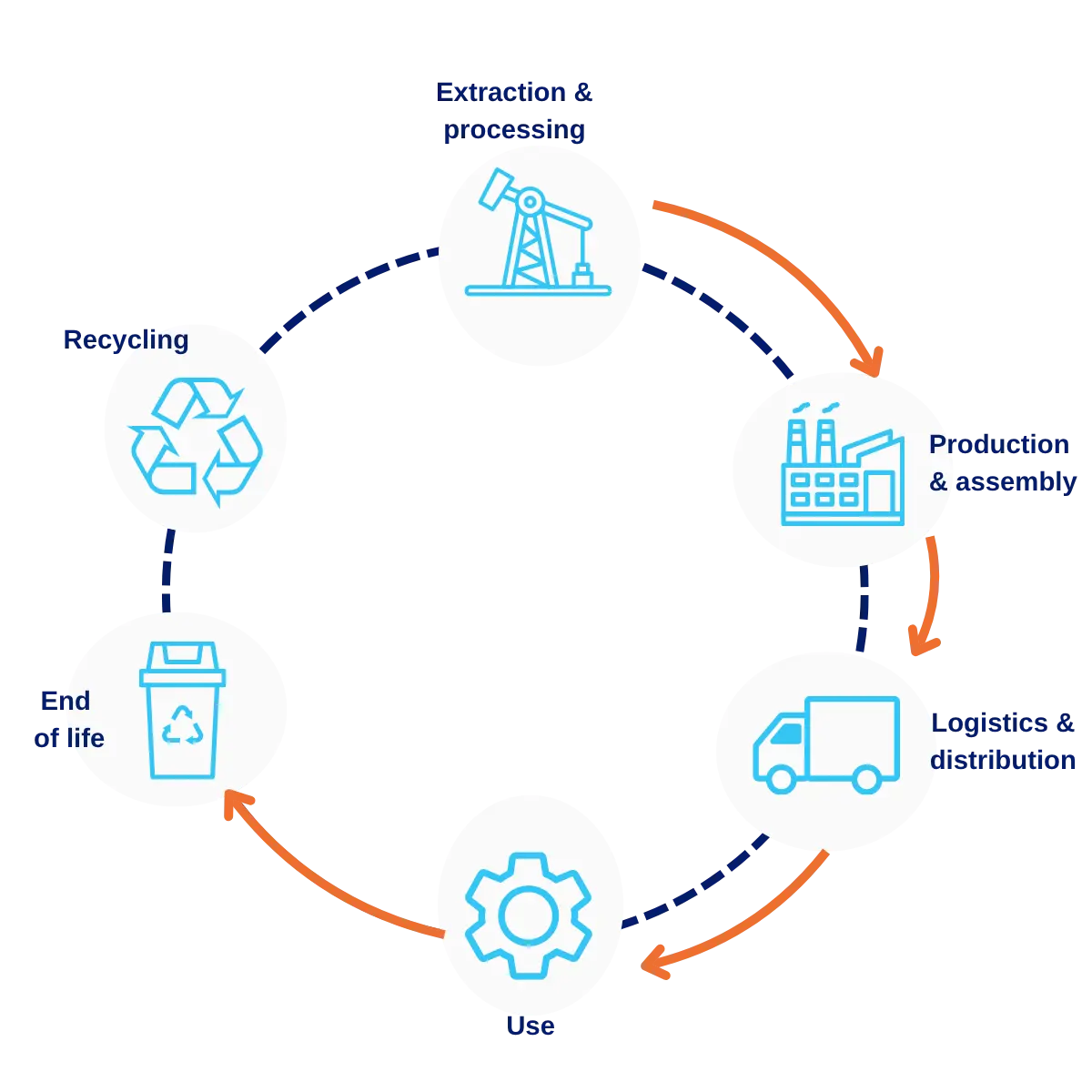
**Life Cycle Assessment (LCA)** is a multi-criteria and multi-stage assessment method standardised by **ISO 14040/14044**. It is used to measure the environmental impacts of a product, process or service throughout its entire life cycle, from the extraction of the necessary resources through to its end-of-life, including manufacturing, transport, distribution and use.
A What is an LCA used for?
Comprendre l’impact
global
Analyze how a product, service, or organization impacts the environment, society, economy, or territory throughout its ENTIRE life cycle.
Orienter les prises
de décision

Identify the most relevant levers for action to reduce negative impacts and enhance positive effects, based on reliable and comparable data.
Optimiser les processus et ressources

Improve overall operational performance by reducing inefficiencies, lowering resource consumption, and promoting a more sustainable use of available resources.
Enhance and substantiate your impact

Communicating transparently about the efforts made on impact reduction with demonstrated results and strengthening the trust of clients and stakeholders.
The normative framework for LCAs
ISO 14040
Defines the fundamental principles and general framework of Life Cycle Assessment (LCA), from goal definition to the interpretation of results.
ISO 14044
Complements ISO 14040 by specifying the requirements, guidelines, data quality criteria, calculations and critical review of an LCA.
ISO 14075
International standard providing the framework for the Social Life Cycle Assessment (S-LCA) of products and the assessment of their social impacts.
ISO 14067
Provides a framework for the quantification and communication of a product’s carbon footprint across its entire life cycle.
What are the different types of Life Cycle Assessment (LCA)?
LCA environmental
Quantifie les impacts sur le climat, les ressources naturelles, la qualité de l’air et de l’eau, permettant à vos équipes de prendre des décisions et de produire des déclarations environnementales certifiées (FDES, EPD, PEP).
Cost analysis
This analysis produce a long-term perspective that supports your eco-design trade-offs” and goes far beyond purchase price as it takes hidden impacts into account.

Social Life Cycle
Assessment
It assesses working conditions, respect for human rights, and impacts on communities across your product’s value chain, from suppliers to the end user.
How do our experts conduct an LCA study?

We define together
your objectives and your needs.

We assist you in collecting
the data of your activities.

We model your activities using
databases

We help you
understand the results.

You take ownership of the results
and implement actions.
How to use LCA for your communication?
Communicating LCA results is essential to transform technical data into clear and actionable information. Even a highly comprehensive study loses value if its results are not understood by teams, partners, or decision-makers. The objective is therefore to make this information accessible, tailored to the target audience, and useful for decision-making, while ensuring its reliability and accuracy.
Discover our article on simplified communication in LCA and learn how to effectively use your LCA results in your communication by making them clearer, more accessible, and better suited to your different audiences.
How is a Life Cycle Assessment verified?
For a Life Cycle Assessment (LCA) to be recognized and reliable, it is essential to subject it to a critical review. This step verifies the methodology, assumptions, data used, and results obtained. Having your LCA study validated by experts strengthens its credibility and facilitates its publication or its use in environmental and strategic decision-making.
For more information on the process and best practices of critical review, consult our dedicated page on critical review in LCA.
Discover our critical review service
Conducting a Life Cycle Assessment (LCA) can represent a significant cost for your project, but several public grants and funding schemes can support you. These mechanisms are specifically designed to support companies engaged in innovation and the ecological transition.
For example, the Booster Transformation Rev3 program helps companies finance sustainable projects, BPI France offers grants and funding for innovative initiatives, and ADEME provides financial support for environmental initiatives and the assessment of the ecological impact of products.
Thanks to these schemes, you can benefit from financial support to carry out your LCA and make your project more responsible and competitive.
Why work with an LCA expert?
Working with an expert consultancy also saves valuable time by providing immediate access to the necessary expertise, without the need for a lengthy period of internal training and skills development.
Our tools to carry out your LCA studies
LCA software


Tools and methods
- ISO and EN standards
- The UNEP guides
- Data collection tools
- Social scoring tools
LCA databases


Take action with our experts!
