


Environmental LCA: Measure the impacts of your products and activities
WeLOOP conducts your Life Cycle Assessments (LCA) to accurately evaluate the environmental impacts of your products, services, or activities. Using a rigorous methodology in line with current standards, our experts identify key improvement levers and support you in implementing concrete actions to reduce your environmental footprint.










Qu’est ce qu’une ACV environnementale ?
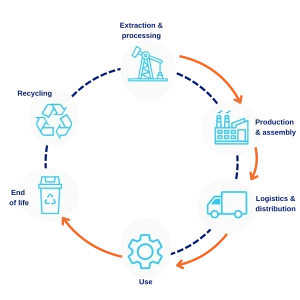
Environmental Life Cycle Assessment (LCA) is the reference method for evaluating the impacts of a product, service, or process throughout its entire life cycle: from raw material extraction to end-of-life.
In the context of the ecological transition, accurately measuring environmental impacts is the first step towards implementing an effective improvement strategy.
Our support dans l’ACV environnementale
The value of an Environmental Life Cycle Assessment (LCA) depends less on the tool used than on the rigor of the initial scoping, the quality of the data collected, and the relevance of its interpretation. WeLOOP supports every stage of the process to ensure the robustness and practical usability of the results.
Our role is to handle the methodological complexity on your behalf while involving you in the key decisions that shape the study, ensuring that your teams fully understand and take ownership of its conclusions.
Rigorous Scoping
Precise definition of the functional unit, system boundaries, and assumptions to ensure results that are aligned with your objectives.
Data collection and modelling
Prise en charge intégrale de l’inventaire des données primaires et secondaires et de leur intégration dans les bases de données reconnues.
Structured Deliverables
ISO-compliant full report, executive summary, and results presentation session, designed to support your decision-making and stakeholder communication.
Une expertise applicable à 4 niveaux d’analyse
WeLOOP draws on extensive expertise in current standards and frameworks, combined with continuous monitoring of regulatory and methodological developments, to ensure the long-term relevance of the studies we conduct.
PRODUCT SCALE
Product LCA
From raw material selection through to end of life, each stage of a product or service’s life cycle is analysed to quantify environmental impacts in a rigorous and traceable manner.
ORGANISATIONAL SCALE
Organisational LCA
Sites, operations, upstream and downstream value chain ACTIVITIES (SCOPE 1 TO SCOPE 3): this approach provides a systemic and consolidated view of an organisation’s overall environmental footprint.
TERRITORIAL SCALE
Territorial LCA
Designed for local authorities and public-sector stakeholders, this scale integrates economic flows, human activities, and natural resources within a territory: municipality, inter-municipal structure.
PROSPECTIVE SCALE
Prospective LCA
When decisions concern emerging technologies or future scenarios, this approach incorporates the expected evolution of energy mixes, industrial processes, and regulatory contexts.
Comment se déroule une ACV environnementale chez WeLOOP ?
Definition of objectives and scope
– Define the product, service, or project under study.
– Define the environmental impacts to be measured (CO2 emissions, energy and water consumption, raw material use, pollution, and biodiversity, etc.).
Life Cycle Inventory (LCI)
– Collect data for each stage of the life cycle while quantifying input and output flows
– Define the environmental impacts to be measured (CO2 emissions, energy and water consumption, raw material use, pollution, and biodiversity).
Environmental Impact Assessment
– Analysis of the collected data to measure environmental impacts.
– Identification of critical points and the most impactful stages using standardized indicators to facilitate the comparison and communication of results.
Interpretation and Recommendations
– Summarize the results to guide decision-making and propose concrete actions to reduce impacts.
– Implement indicator monitoring and ensure transparent communication of the results to stakeholders.
Why choose WeLOOP for your Environmental Life Cycle Assessments

+300 LCAs completed

Several years of experience in environmental LCA

Expertise compliant with current standards and regulations
An approach tailored to a wide range of
industries
Nos services complémentaires
Focus sur quelques projets

The BATTERS Phase 1 project aimed to build a roadmap to guide the decisions of the Hauts-de-France region in managing the newly formed Battery Valley in a new regulatory context with the new battery regulations. An environmental life cycle assessment (LCA) of the annual battery activity and the availability of critical materials at the scale of Hauts-de-France in a future stable market (2070) was carried out, along with interviews with industrial and institutional stakeholders.
The project started a second phase in 2025 with the launch of the BATTERS Phase 2 project, which aims to facilitate collaboration among regional stakeholders in environmental initiatives by developing a collaborative platform on environmental life cycle assessment (LCA), criticality, and eco-design at the product level across the entire battery value chain, from active materials to recycling.
To concretely assess the environmental benefits of reuse, WeLOOP supported Le Fourgon in carrying out of a Life Cycle Assessment (LCA) comparing several reusable packaging options and single-use solutions.
The study aimed to determine after how many uses a reused bottle becomes more environmentally advantageous than a disposable bottle.
The results of this LCA have been reviewed by an independent panel of experts to ensure their robustness and enable transparent communication with the general public.

WeLOOP supported the company Colruyt Group in a Life Cycle Assessment (LCA) approach aimed at evaluating the environmental impacts of various R&D projects related to agri-food production, from the initial stages to industrial-scale development.
The objective of this approach was to integrate eco-design principles from the earliest stages of projects in order to assess their relevance from an environmental perspective and to optimize their impacts as much as possible throughout development.
Our environmental LCA experts
 Naeem Adibi
 Dr. Carolina Szablewski
 Noura Rhabani
 Dr. Dieuwertje Schrijvers
 Dr. Anish Koyamparambath
 Perrine Sébastien
 Clément Bolle
 Emilie Guilvert
 Sam Herlicq