

Allocation in LCA isn't a problem to solve, it's a perspective to choose
Dieuwertje Schrijvers
Why do two correct LCAs of the same recycled material give different answers? The reason is allocation: the way the environmental impacts of a multifunctional process, such as recycling, are distributed between products. There is no single correct allocation method: partitioning, system expansion, substitution, the cut-off method, or normative rules (e.g. EN 15804) each give a valid answer to a specific question, and the choice between them depends, among others, on whether your LCA is attributional or consequential. In a circular economy, where materials cascade across multiple life cycles, choosing the right allocation perspective is what makes an LCA result trustworthy and comparable.
One value chain, two LCAs, two different answers
The construction sector is working to become more circular by increasing the recycled content of its products and enabling the valorisation of products at the end of life. Downstream industries are increasingly using that recovered material to reduce the environmental footprint of their own products. Let’s look at an actual example, in which a manufacturer of insulation material incorporates recycled newspapers in its product, and, at the end of life, the insulation material is converted into biochar by pyrolysis, for use as a fertiliser in the agricultural sector. To demonstrate the benefits of these efforts, both the insulator manufacturer and the agricultural user of the biochar could commission a life cycle assessment.
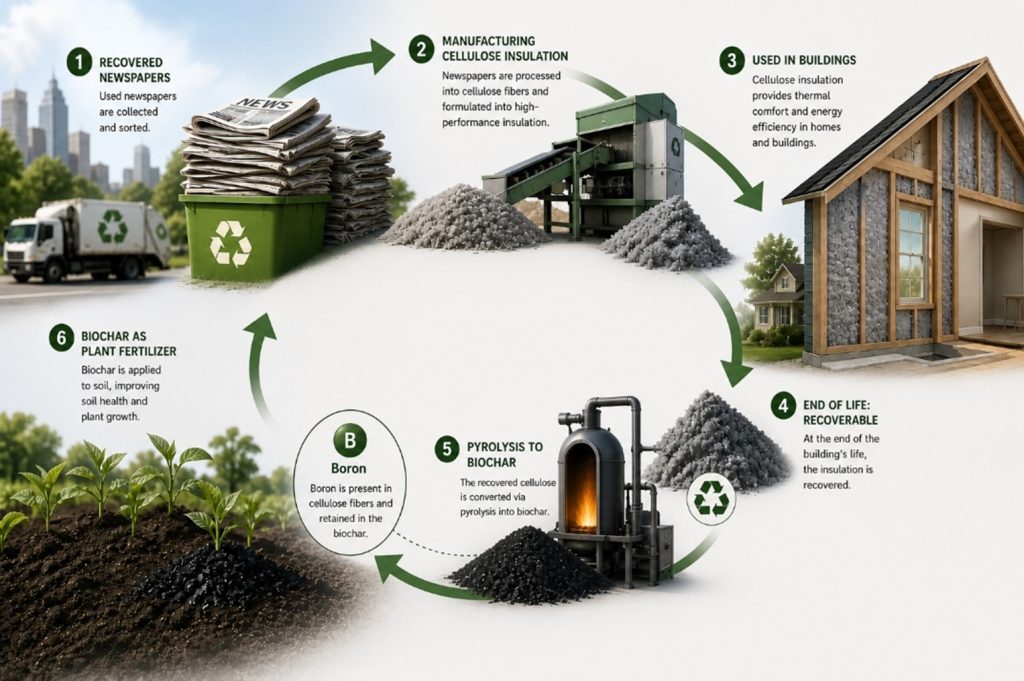
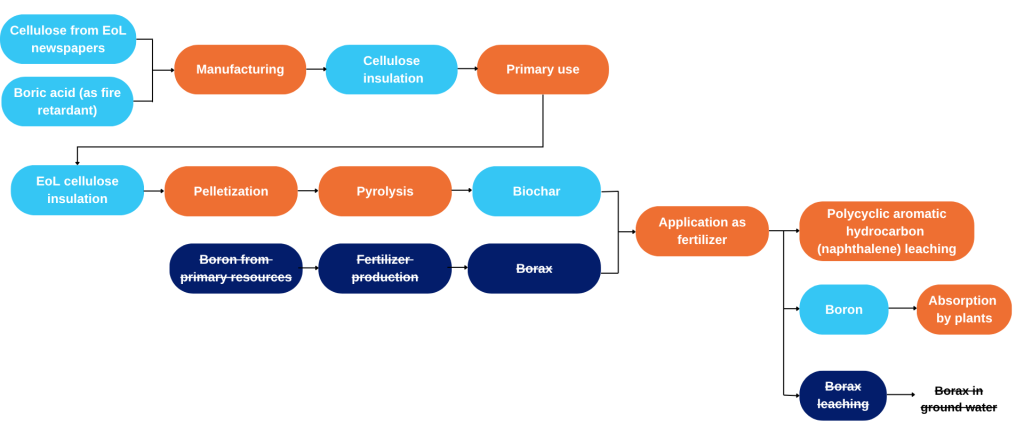
The first LCA, commissioned by the cellulose insulation manufacturer, can display a low carbon footprint per square metre, as it credits the avoided production of virgin fertiliser at end of life through biochar production. The second, commissioned by an agricultural user of that same biochar, also displays a low footprint, as it treats the end-of-life insulation material as a waste input arriving with no environmental burden. Both studies are independently verified. Can they both be true?
Someone may say that one of these studies is wrong. However, this is not necessarily the case. To explain why two correct studies can contradict one another, I should like to borrow an old story.
The elephant in the room
Six blind men were brought before an elephant and asked to describe it. The first reached out and felt a great wall — broad, leathery, warm. “An elephant is a wall,” he said. The second touched a smooth, curved tusk: “No, it is a spear.” The third found the trunk: “It is a thick, breathing snake.” The fourth pressed his palm against a leg: “A pillar of a tree.” The fifth ran his hand along an ear: “A great fan.” The sixth grasped the tail: “A piece of rope.”
Each of them was telling the truth about what he could feel, but none of them was telling the truth about the elephant. The elephant was all of those things at once. This is what allocation looks like in LCA.

Each method is built for one question
If I encounter a situation that requires allocation, I spend a long time on a seemingly simple question: What is your study actually about? Every methodological choice that follows depends on this question, and most allocation disputes I have encountered turn out to be unspoken disagreements about scope.
If you look at the cellulose value chain, at least five legitimate research questions live inside it.
The insulation manufacturer wants to know the footprint of one square metre of her product. She needs to quantify these impacts in accordance with the normative rules of EN 15804, which prescribe accounting rules for attributing impacts to products in the construction sector.
The biochar user may conduct the LCA in the context of a research project. The researcher wants to know whether an agricultural process using biochar is less accountable for impacts than when other sources of plant fertiliser are used, and the results are published in a scientific paper. The researcher aims to be ISO 14044-compliant, and the paper must pass peer review.
Both studies are product-oriented, but the results will be published to different audiences, who have a different understanding of “for which impacts should a product be accountable”.
We can also consider additional stakeholders who may wish to conduct an LCA for the same value chain. The recycler running the pyrolysis process asks a different kind of question: what is the environmental performance of the pyrolysis process that takes in one tonne of post-use cellulose and produces biochar? Is this process environmentally favourable over alternative waste valorisation routes? This is process-oriented. The whole multifunctional process is the unit of analysis; there is nothing to allocate, because no product is being isolated.
A policy analyst may ask about the influence of reduced availability of recyclable newspapers on their cascading use in the cellulose insulation industry, followed by the use of valorised biochar in the agricultural sector. Here, the entire cascade chain is of interest; again, allocation is unnecessary.
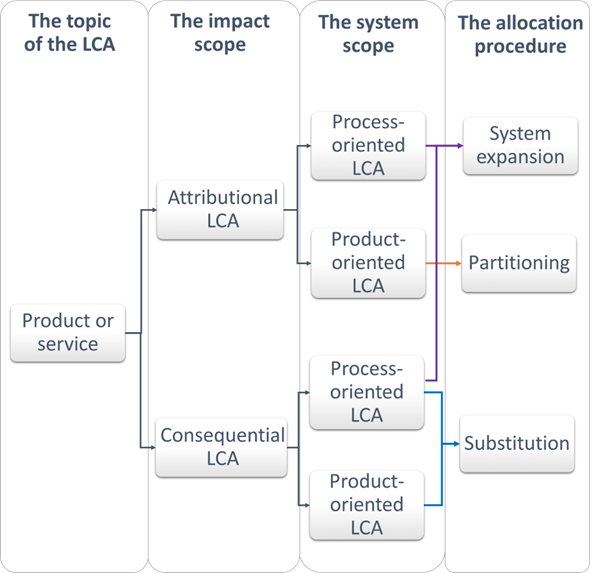
We may not only switch the scope of our system from product-oriented to process-oriented, or even consider multiple life cycles in a cascading system. We can also apply a different impact scope. The sustainability manager of the insulation firm may want to know whether diverting end-of-life insulation material to biochar production processes actually reduces global emissions, or whether alternative end-of-life solutions should be favoured instead. Here, the LCA impact scope does not focus on a single actor or process’s “accountability for impacts” but encompasses global impacts, and the LCA practitioner will conduct a consequential LCA, rather than an attributional LCA.
At least five questions, one elephant. Each question requires a different allocation approach. Partitioning, system (or functional-unit) expansion, substitution, or, in some cases, we can make do with the cut-off approach. These are not competing methods to respond to the same question. They are tools built around different questions, and each gives a coherent answer that is correct for its question and incoherent if you mistake it for an answer to a different one. Practitioners who do not see this, end up arguing about whose number is right, when the real disagreement is about whose question is being answered.
Even the right allocation method has a fixed reach
There is a second level of blindness, and it lies at the heart of a paper we recently published in Frontiers in Sustainability with colleagues from LIST, Neovili, Contactica and IVL, as part of the EU Horizon Europe CALIMERO project.
We asked a different question: across the circular bio-economy, which circularity strategies can each LCA method actually see? Will any effort in applying a circularity strategy within a product system result in a changed outcome of an LCA study? We assembled forty-eight circularity strategies — from material recovery rates to cascading uses, from quality preservation to lifetime extension and screened them against six prominent LCA methods (PEF, EN 15804, Allocation at the Point of Substitution (APOS), consequential LCA, and two variants of system expansion) and three stand-alone circularity indicators (MCI, CTI, and ISO 59020:2024). Furthermore, we illustrated the application of the modelling requirements of the LCA methods We tested the framework
The comparison showed that no single method or stand-alone circularity indicator covered all circularity strategies. The cascading of materials across successive uses, upcycling versus downcycling, improved recycling efficiency rates: these are visible to some hands on the elephant and not to others. This means that the blindness of an LCA practitioner is structural. It cannot be fixed with better data.
In other words, even when a practitioner has correctly chosen the method that matches her research question, that method’s perspective only reaches part of the elephant. The missed parts of the elephant are not method flaws; they are simply out of scope.
The blind men compared notes
The version of the parable of the blind men and the elephant that I came across in one of my children’s books ends in a disagreement. But it appears that there is another version in which the blind men eventually sit down together and compare what each of them has felt. Out of six partial truths, they assemble something that is no longer partial. Even though none of them saw the entire elephant, together, they describe one.
That is what we proposed in the Frontiers paper. Tandems of methods, chosen deliberately and run in parallel, can give you a (more) complete picture of the valorisation chain. The insulation manufacturer’s product-oriented attributional LCA and the recycler’s process-oriented system expansion and the sustainability manager’s consequential view, presented side by side, tell a richer story than any one of them on its own, and they stop being a contest about which number is “the right one.”
Allocation isn’t a problem to be solved; it’s a perspective to be chosen. The more perspectives we combine, the more of the elephant we see.
Do you want to learn more?
The Frontiers paper is available in open access and presents a systematic mapping of 48 circularity strategies across six LCA methods and three standalone circularity indicators. It gives you a steer on "which method should I use, and what will it miss?"
The next time someone presents you with an LCA figure for a recycled, recovered, or otherwise valorised material, ask them which part of the elephant they were holding when they measured it.