

How to reduce the environmental impact
of a building envelope by 75%?
Sam Herlicq
Facing environmental challenges and new regulations, companies are increasingly rethinking their products and manufacturing processes.
It is in this context that the company Envelnor-Kuvert, specialized in envelope manufacturing, has launched a eco-design approach to reduce the environmental impact of its products.
To measure the real benefits of this transformation and access public funding, the company relied on the expertise of WeLOOP in Life Cycle Assessment and eco-design.
The company carried out a project to modify its envelope production in order to reduce its environmental impact. As part of this project, WeLOOP conducted a comparative LCA between the old and the new production, in order to assess the environmental benefits of the project and obtain funding from ADEME.
The eco-design project of Envelnor-Kuvert
Based in Hauts-de-France, Envelnor-Kuvert has been manufacturing and printing envelopes and mailing pouches since 1998.
The company has committed to an ambitious project aimed at reducing the environmental impacts of its envelopes by redesigning their design and production process.
The project is based on major changes:

Thanks to this new design, the envelope directly wraps the contents, which makes it possible to significantly reduce the amount of material used.
This transformation required investment in new production machinery to replace existing production lines that were highly dependent on plastic materials.
The support of WeLOOP and funding from ADEME
To support this eco-design project, Envelnor-Kuvert mobilized the ADEME funding program dedicated to reuse, reduction, and substitution of packaging and containers, particularly single-use plastics. This scheme is part of the continuation of the AGEC law, which aims to accelerate the ecological transition and reduce single-use plastics.
However, obtaining this type of support requires scientific demonstration of the environmental benefits of the project. In this context, WeLOOP supported the company by conducting a comparative Life Cycle Assessment between the old and the new envelope production.
The LCA study was carried out according to:
- The EF 3.1 impact assessment method (European Commission);
- The Ecoinvent 3.11 background database.
This methodology makes it possible to assess environmental impacts using 16 different indicators (e.g. climate change, resource use, acidification, etc.). These indicators can then be aggregated into an overall single-score assessment in order to compare different design solutions.
Highly significant environmental results
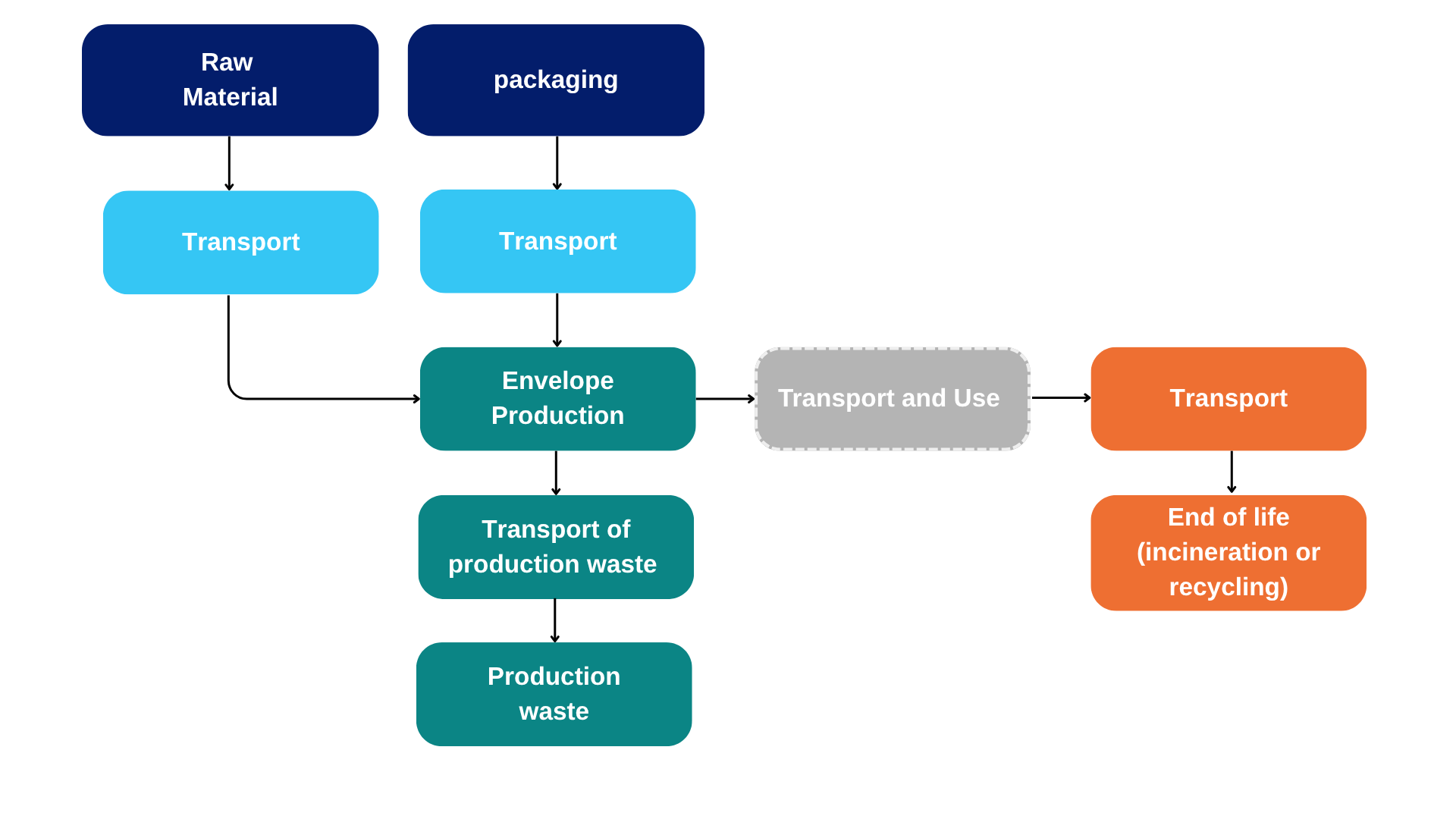
The study considers the entire life cycle of the envelopes, including raw material sourcing, manufacturing, and end-of-life. The impacts of transport and use were not studied, as they are considered identical for both versions.
However, as the new envelope is lighter, its transport also generates a lower direct environmental impact.
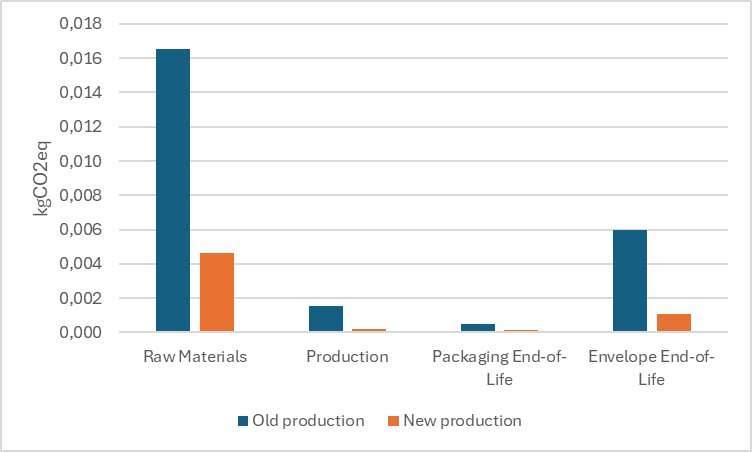
The study results are particularly significant, with a 75% reduction in environmental impacts, including global warming.
The main impact indicator is climate change, particularly due to the energy required for paper production.
The main identified improvement levers
The study identified several drivers responsible for these impact reductions.
- Optimization of material usage
Paper grammage has been significantly reduced, from 115 g/m2 to approximately 25 g/m2. This optimization substantially reduces material consumption, the energy required for production, and the waste generated.
- Elimination of plastic
The removal of the plastic window is a major lever. In the previous version, the plastic could not be separated from the paper: the envelopes were not recyclable.
The study therefore considered a 100% incineration scenario for these envelopes (previous version). With the new 100% paper version, the envelopes can now follow the average paper waste treatment in France (Eurostat, Appendix C), which includes a recycling share. This change improves the product’s environmental performance.
- Optimization of the production process
The new design also enables a reduction in manufacturing energy consumption, as well as in the quantity of waste generated.
WeLOOP, your partner in eco-design initiatives
This project illustrates the importance of measuring the environmental benefits of innovation projects. Through the Life Cycle Assessment conducted by WeLOOP, Envelnor-Kuvert was able to:
Beyond LCA studies, WeLOOP supports companies in all their eco-design initiatives, in particular through:
The methodology developed by WeLOOP encourages close collaboration between stakeholders in order to develop concrete, relevant, and operational solutions.