

The Illusion of Stability: Can Geopolitical Risk Be Quantified?
Anish Koyamparambath
The beginning of 2026 has already shown how fragile global supply systems remain. Energy resources such as crude oil and LPG are under pressure again. Even helium often overlooked is now part of the concern. But were these risks really unexpected? Can we identify them earlier? Can geopolitical risk be quantified and integrated into our assessments? Understanding risk is no longer optional. It is necessary for better decisions. In our latest article, we explore how existing methods can help anticipate and assess these vulnerabilities.
Drivers of Supply Disruptions
Since 2022, the global economy has entered a period in which supply conditions are changing quickly, especially for energy and raw materials. Supply risks are not new, but what is notable today is that materials once considered stable are again becoming uncertain. This shift is largely driven by geopolitical factors. The Russia–Ukraine conflict pushed the European Union to act more strongly in diversifying its energy sources and reducing dependence on a limited number of suppliers. At the same time, policies aimed at strengthening energy independence have gained importance.
Researchers have long warned that global supply systems are complex and tightly interconnected1. This means that disruptions in one region can quickly affect others. As countries, particularly in Europe, adapt to these changes, new tensions have added further pressure. Recent developments around the Strait of Hormuz, a key route for oil transport, have disrupted trade from the Persian Gulf. This route is essential for global energy flows, and any restriction has immediate effects on supply. The strategic importance of the Strait of Hormuz has long been established2. Around one fifth of global oil consumption and a significant share of maritime oil trade pass through this narrow passage, making it one of the most critical chokepoints in the global energy system. Even the threat of disruption can increase market uncertainty and lead to price volatility3.
Global Energy Supply Dependencies
Countries in and around the Persian Gulf, including Saudi Arabia, Qatar, United Arab Emirates, Iran, Iraq, Oman, and Kuwait, depend heavily on fossil fuel exports. Around 53.9% of their exports come from crude oil, and when including other fossil fuels, this rises to about 77% of total export value (2024 values). Together, these exports represent about 16% of global energy trade. The region is also important for helium supply, with Qatar being one of the largest producers.4 In recent events, temporary shutdowns in this region removed a significant portion of global helium production within a short time, showing how quickly supply chains can be affected.
This situation directly affects importing countries. France depends on the region for more than 13% of its resources, while the United States relies on it for around 10%. The impact is already visible: fuel prices have risen rapidly, and some countries are struggling to meet demand. This adds further pressure to an already fragile global economy. In some sectors, the challenge is not only rising prices but also availability. Industries that depend on helium, such as semiconductor manufacturing and healthcare, may face shortages even if they are willing to pay higher prices4. More broadly, energy systems are exposed to different types of risk, including long-term pressures such as geopolitical tensions and short-term shocks such as infrastructure failures. These risks can propagate through interconnected supply chains, making disruptions more complex and harder to manage.
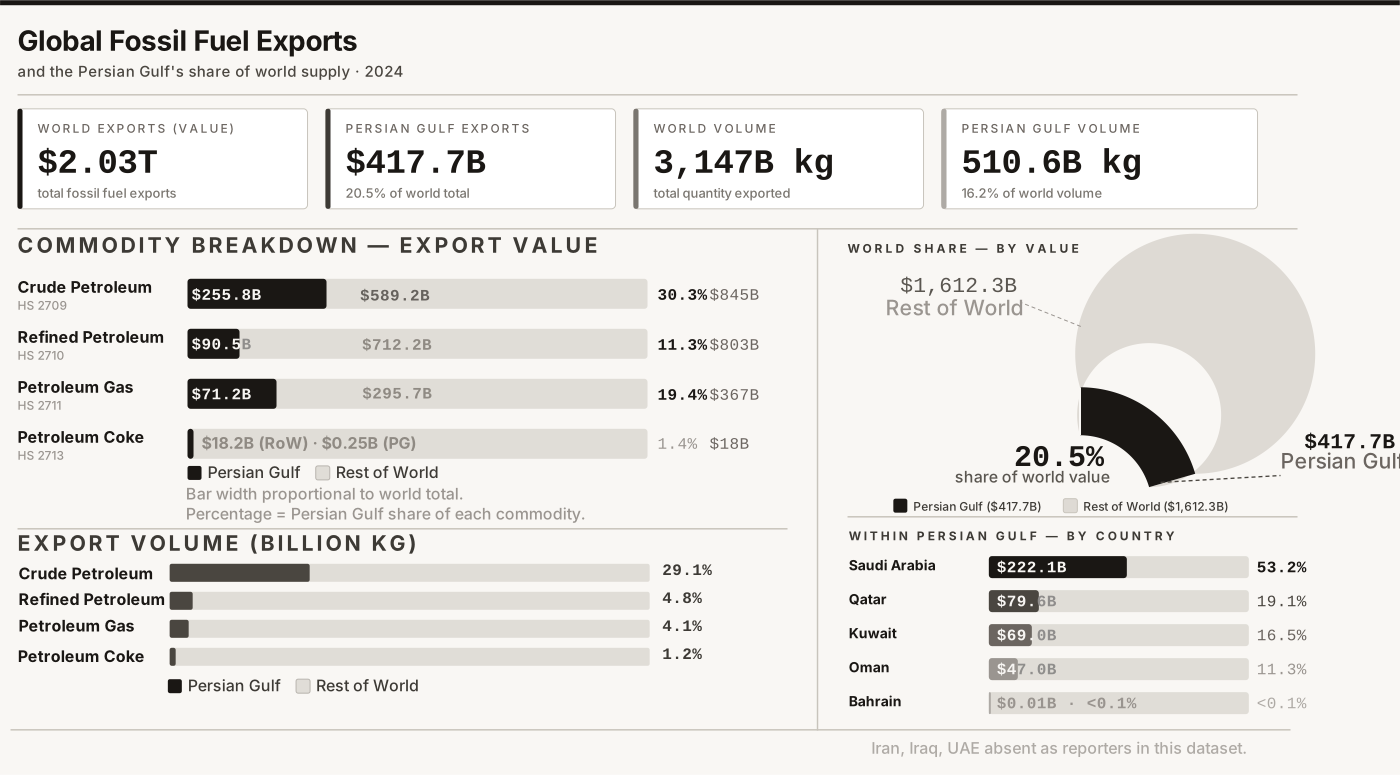
These developments raise an important question: “could such risks have been identified earlier, and can future disruptions be reduced?”
Quantifying Geopolitical Risk in Supply Chains
Geopolitical events are difficult to predict, but certain tools can help assess potential risks. One example is the GeoPolRisk method7, which focuses on geopolitical conditions in producing countries. This method uses data from the Worldwide Governance Indicators, developed by the World Bank8. In particular, it relies on a measure called “Political Stability and Absence of Violence”, which scores countries between −2.5 and +2.5. The GeoPolRisk approach combines this score with the share of imports coming from each country. In simple terms, it shows the extent to which a supply depends on countries that may face political instability.
This method has also been applied in Life Cycle Assessment (LCA)9–11, which examines the impacts of products and systems. By incorporating geopolitical risk into this analysis, it becomes easier to identify which materials or stages are more exposed to supply disruptions. This helps businesses and policymakers take preventive action.
Other tools, such as the IRTC framework12, aim to provide a broader view by linking environmental, social, and economic factors with accessibility, price, and reputation risk. At the policy level, the Critical Raw Materials Act13 focuses mainly on metals and minerals. However, recent events show that similar attention is needed for fossil fuels.
It is important to note that metrics like the GeoPolRisk method do not predict crises. Instead, they highlight where risks may exist. This information can support better planning and decision-making. When used properly, such methods can help identify hotspots in supply systems and guide actions to reduce dependence or diversify sources. However, the decisions made are entirely dependent on the quality and scope of the underlying information, which may not reflect all potential threats. The Worldwide Governance Indicators measure “how likely it is that political power will be disrupted through violence or illegitimate means,” but they do not capture bilateral relationships or sudden policy changes.
With the United States playing a significant role in the current tensions in the Persian Gulf, and in light of the proposed ceasefire, there is a degree of cautious relief. However, the global economy has already experienced shocks related to fossil fuels, particularly during the 1970s14. While the world was able to adapt and mitigate these disruptions, similar challenges are re-emerging. This recurrence highlights the need to strengthen resilience by improving how risks are identified, assessed and addressed through appropriate mitigation strategies.
In this context, WeLOOP applies these methods to support businesses and stakeholders. In recent projects, WeLOOP has developed and implemented a consistent approach to assess supply risks by combining life cycle thinking with geopolitical and resource assessments. Building on this experience, WeLOOP has applied tools such as GeoPolRisk to measure geopolitical exposure and combined them with broader frameworks (IRTC tool) to incorporate environmental, social and economic dimensions. This integrated approach not only helps identify vulnerable materials and supply chains, but also supports the development of mitigation strategies based on diversification, recycling and improved resource management.