


Preparatory work on the revision of EN 15804: building consensus for the EPDs of tomorrow
Naeem Adibi
EN 15804 is currently the methodological foundation of Environmental Product Declarations (EPDs) in the construction sector. It provides a harmonized framework for assessing and communicating the environmental performance of construction products across Europe.
In response to the rapid evolution of the European regulatory framework, the growing development of the circular economy, and increasing market expectations regarding sustainability, a significant preparatory revision of the standard is currently underway. This work goes far beyond a simple update of a few technical requirements; it aims to adapt the entire methodological framework to the challenges that will shape the construction sector over the coming decades.
A convergence point for multiple european initiatives
To understand the preparatory work for the revision of EN 15804, it is first necessary to understand that it does not take place in an isolated environment.
Today, several European initiatives are progressing simultaneously in the field of environmental assessment of construction products. On one hand, the revised Construction Products Regulation (CPR) is redefining the regulatory requirements applicable to construction products. At the same time, the development of the Product Environmental Footprint (PEF) continues with the objective of harmonizing environmental assessment methodologies across Europe. Other initiatives focus on building assessment standards, infrastructure assessment frameworks, future European environmental databases, the requirements of notified bodies, and sector-specific Product Category Rules (c-PCRs).
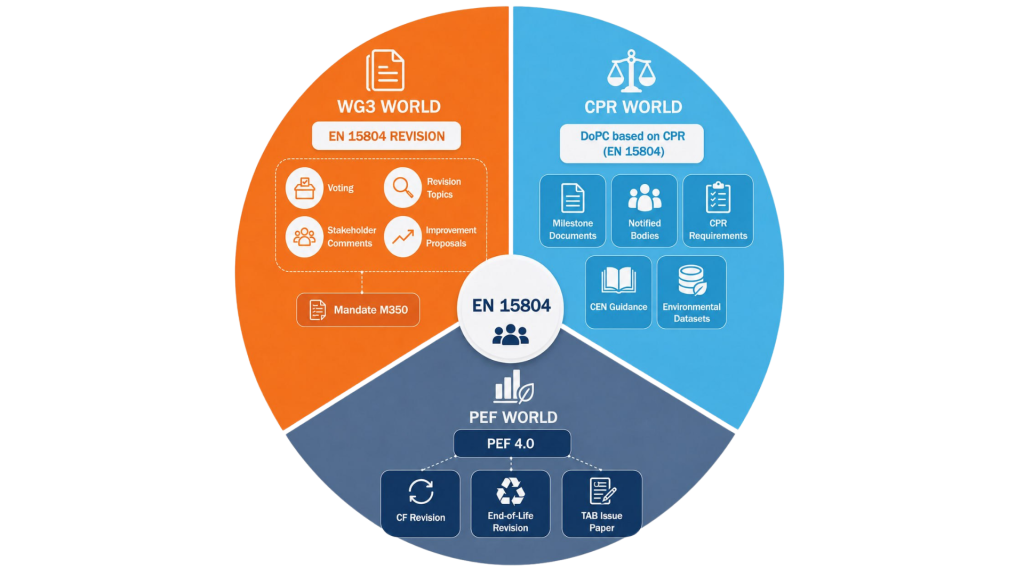
Today, EN 15804 stands at the crossroads of these various initiatives. Each brings its own objectives, terminology and, at times, distinct methodological approaches. A major challenge of the preparatory work is therefore to reconcile these different perspectives and build a coherent framework capable of supporting the next generation of EPDs.
This context helps explain why progress on certain topics is necessarily gradual and requires in-depth discussion. More than a simple revision of a standard, the process reflects a broader effort to align multiple technical and regulatory frameworks that will continue to evolve in the years ahead.
The ultimate objective is to achieve greater harmonization across the various European frameworks, enabling manufacturers, EPD users, verification bodies, and public authorities to rely on consistent and widely recognized rules.
Preparatory work for the revision structured around several key thematic areas.
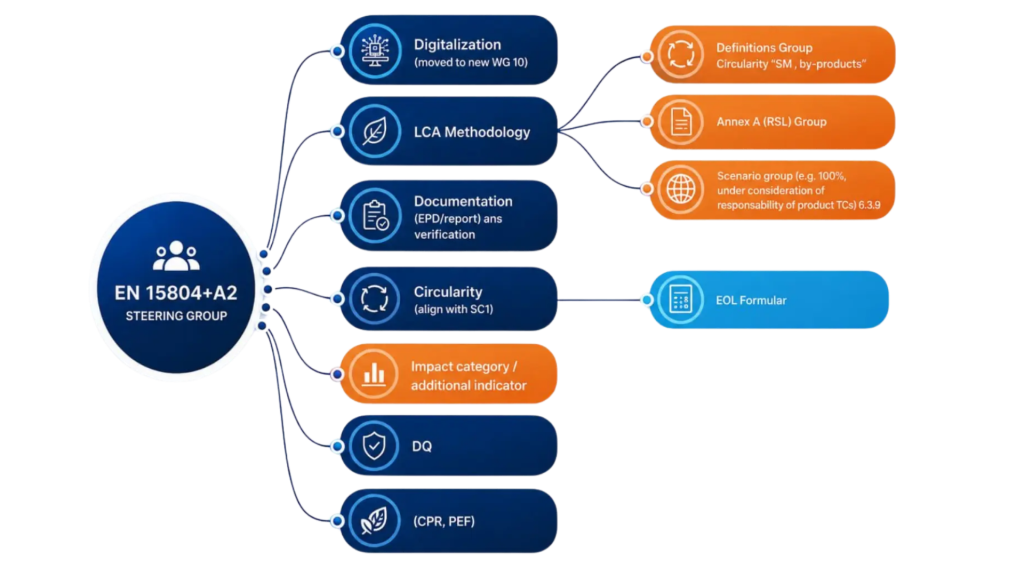
The preparatory work for the revision relies on several specialized working groups, each responsible for examining a specific area of the standard. This organization reflects the diversity of the topics involved and the need to converge sometimes differing perspectives within the European EPD community.
The ongoing work focuses in particular on:
- the harmonization of definitions;
- end-of-life scenarios;
- reference service life of products;
- secondary materials and the circular economy;
- additional environmental impact indicators;
- data quality;
- documentation, verification, and digitalization of EPDs.
The objective is to ensure that future EPDs remain comparable, robust, and aligned with emerging market needs.
Circular economy at the core of the discussions
One of the main drivers of this preparatory work is the desire to better integrate the principles of the circular economy.
Today, EPDs already make it possible to assess the environmental impacts of a product throughout its entire life cycle. However, stakeholders in the sector also seek to better understand how a product contributes to resource preservation, material reuse, and waste reduction.
Current discussions therefore focus on how to more accurately represent secondary material flows, recycling, reuse, and the preservation of material value over time.
This evolution is essential, as circularity is gradually becoming a criterion as important as traditional environmental impacts.
Rethinking end-of-life scenarios
End-of-life scenarios are one of the most complex topics within the preparatory work.
Current methods make it possible to model different options such as recycling, energy recovery, or waste disposal. However, several analyses have shown that some approaches can lead to inconsistencies when comparing different theoretical scenarios.
Ongoing work seeks to improve methodological consistency so that the results more accurately reflect the benefits and burdens associated with different end-of-life options.
Beyond technical aspects, these discussions raise a broader question: how to properly account for the benefits of the circular economy in EPDs without compromising their comparability?
Better accounting for product service life
Product service life is another major topic of the preparatory work.
From a sustainability perspective, a product designed for long-term durability may offer significant advantages compared to a product requiring frequent replacement. However, the way service life is currently taken into account remains heterogeneous across product categories.
The work therefore aims to define more harmonized rules enabling the link between product durability performance and environmental assessments. This evolution should also improve consistency between assessments carried out at product level and those performed at building level.
Harmonizing definitions across Europe
The preparatory work for the revision also highlights a significant need for terminological harmonization.
Over the years, several European standards have introduced similar concepts that are sometimes defined differently. Concepts such as secondary materials, circularity, life cycle, and end-of-waste status are not always described consistently across the various reference documents.
One of the objectives of the preparatory work is therefore to build a common language that ensures greater consistency between the various European standards related to the sustainability of construction.
This harmonization represents a key step toward facilitating the interpretation of EPDs and strengthening their credibility among users.
Towards new resource use indicators
Discussions are also focusing on the potential introduction of new indicators to better represent the use of natural resources.
Current indicators effectively capture environmental impacts such as climate change and energy consumption. However, several stakeholders believe that they do not always provide a clear picture of the quantities of raw materials mobilized throughout the life cycle.
In this context, discussions are underway regarding the potential introduction of additional indicators dedicated to material flows and resource efficiency. Such an evolution would strengthen the ability of EPDs to support European objectives related to resource conservation and circularity.
A major impact on EPD programme operators
Beyond methodological developments, the future preparatory work on EN 15804 will also have significant implications for all EPD programme operators across Europe, such as INIES, IBU, EPD Norge, EPD Italy, B-EPD and the International EPD System. Historically, each major revision of EN 15804 has required adjustments to programme rules, verification procedures, declaration formats and, in some cases, even the digital platforms used for EPD publication.
The transition from EN 15804+A1 to EN 15804+A2 is a striking example: it led to the introduction of new environmental indicators, the update of thousands of existing EPDs, the evolution of LCA tools, and a coexistence period between old and new declarations that lasted several years.
The future revision could have a comparable, or even greater, impact given the topics currently under discussion: circular economy, secondary materials, new resource indicators, data quality, digitalization, and the potential evolution of the rules relating to Module D. Programme operators are therefore closely monitoring this work, as the methodological choices that will ultimately be adopted will directly influence the future requirements applicable to manufacturers, verifiers and EPD users across Europe.
A process that will still require several years
To avoid any ambiguity, it should be clarified that the EN 15804 standard is not currently under revision. It was indeed decided last year not to initiate a revision at this stage, in order to ensure regulatory and methodological stability for all stakeholders in the sector.
The CEN/TC 350 has nevertheless initiated preparatory work in order to anticipate the European Commission’s forthcoming standardization request, expected by the end of 2027. This work aims to prepare future discussions and identify the key topics that will need to be addressed once the mandate is officially launched.
Issues related to circularity, secondary materials, end-of-life scenarios, product service life, as well as new indicators are closely interconnected and require significant coordination efforts. In many cases, discussions still concern topics that have not yet reached a European consensus.
In this context, no new version of EN 15804 is expected before 2029–2030. The preparatory work undertaken in the meantime should help to bring the various positions closer together, clarify certain key concepts, and consolidate the methodological framework needed to support the transition of the construction sector towards a more circular, more transparent, and more sustainable economy.
The objective is to preserve the role of EN 15804 as a reference for the environmental assessment of construction products, while addressing the emerging challenges of the coming decade.
Anticipating changes in environmental standards with WeLOOP
Methodological frameworks related to environmental product assessment are continuously evolving to better reflect current challenges in sustainability, transparency and environmental performance. In this context, industrial companies and manufacturers must adapt their data and assessment practices to ensure the reliability and comparability of their results.
WeLOOP supports organisations in conducting LCAs and developing EPDs and FDES, as well as in analysing and integrating methodological and regulatory developments. With extensive expertise in European standards and life cycle assessment practices, we help our clients secure their environmental declarations, improve data quality and structure their approaches within a continuous improvement framework.
Whether for the development of new environmental declarations or the update of existing documents, our experts provide support at every stage to ensure robust, consistent and compliant results that meet current requirements.