


"Bilan Carbone" or " Empreinte Carbone": What’s the difference?
Emilie Guilvert
When developing a project or seeking to understand the environmental impact of our activities, we often refer to a “bilan carbone” or an “empreinte carbone”. These French terms are often used interchangeably, but their meanings vary depending on the context.
The difference between these terms depends on the context, the subject being assessed and the methodology used. “Bilan Carbone®” refers to a specific methodology, while “empreinte carbone” is a more general term that can apply to a product, service, organisation or territory.
Why is this confusion so common?
Both approaches are based on the same reality
- Both approaches quantify greenhouse gas (GHG) emissions that contribute to climate change. The main gases and groups of gases accounted for are carbon dioxide (CO₂), methane (CH₄), nitrous oxide (N₂O), hydrofluorocarbons (HFCs), perfluorocarbons (PFCs), sulphur hexafluoride (SF₆) and nitrogen trifluoride (NF₃).
- Results expressed in kilograms or tonnes of CO₂ equivalent (kg CO₂eq or t CO₂eq).
- Methodologies based on similar principles for accounting for emissions and measuring environmental impacts.
A Matter of Terminology Rather Than Science
There is no universally accepted definition that draws a strict distinction between these two terms. Depending on the context, the distinction may relate to the subject being assessed (organisation or product), the scope considered (territorial or consumption-based), or simply common usage. In France, the widespread adoption of the Bilan Carbone® methodology, originally developed by ADEME, has had a particularly strong influence on terminology.
What does “Bilan Carbone®” refer to?

The term Bilan Carbone® originally refers to a methodology developed by ADEME in the early 2000s, now managed by the Association pour la transition Bas Carbone (ABC). This methodology was designed to help organisations quantify their direct and indirect emissions and develop low-carbon transition plans.
The Bilan Carbone® methodology aims to identify and quantify significant direct and indirect emissions associated with an organisation’s activities, within the defined scope, in order to develop a transition plan. A GHG inventory is therefore not necessarily a Bilan Carbone®: this designation specifically refers to the application of the corresponding methodology. Results are broken down by emission source categories, which are now often reclassified according to the GHG Protocol scopes to meet regulatory and international requirements.
Internationally, the most widely used framework for reporting an organisation’s impact on climate change is the GHG Protocol Corporate Standard, developed by the World Resources Institute (WRI) and the World Business Council for Sustainable Development (WBCSD). It is now the global reference standard for organisational carbon accounting.
The GHG Protocol has thus popularised the distinction between:
Scope 1
Direct emissions from sources owned or controlled by the organisation, according to the chosen consolidation approach.
Scope 2
Indirect emissions associated with the generation of purchased or acquired electricity, heat, steam and cooling consumed by the organisation.
Scope 3
Other indirect emissions associated with the organisation’s upstream and downstream value chain.
Another widely used standard is ISO 14064-1, which also sets out requirements for quantifying and reporting GHG emissions at the organisational level. It is compatible with the general principles of the GHG Protocol while following its own structure. The GHG Protocol and ISO are working together to develop a harmonised standard for organisational GHG accounting and reporting. This initiative aims to bring together the Corporate Standard, the Scope 2 and Scope 3 standards, work on actions and market-based instruments, and ISO 14064-1. According to the timetable announced in July 2026, a public consultation is scheduled for the second quarter of 2027, with publication planned for the fourth quarter of 2028.
What does “Empreinte Carbone” refer to?
When referring to an empreinte carbone, the term is very often associated with a product or service rather than an organisation. The aim is to assess the GHG emissions generated throughout the life cycle of the system being studied, from raw material extraction through to the product’s end of life.
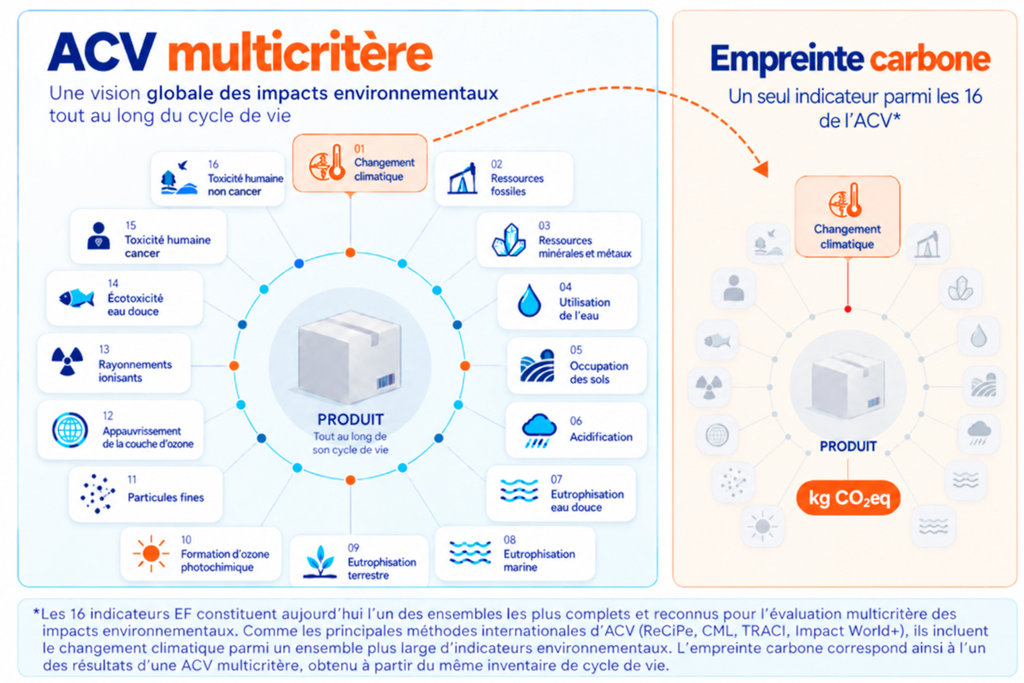
Cette approche repose sur les principes de l‘Life Cycle Assessment (LCA) définis par les normes ISO 14040 et ISO 14044. Contrairement à une ACV complète qui évalue plusieurs indicateurs d’impact environnementaux, l’empreinte carbone ne s’intéresse qu’à une seule catégorie d’impact : le changement climatique.
The key international standard is ISO 14067, which sets out the requirements and guidelines for quantifying the carbon footprint of products. This standard allows for both full (“cradle-to-grave”) and partial (“cradle-to-gate”) assessments, depending on the objectives of the study.
Dans l’écosystème du GHG Protocol, un autre référentiel est le GHG Protocol Product Standard, utilisé pour calculer les émissions associées à un produit sur l’ensemble de son cycle de vie.
What does a territory’s bilan carbone or empreinte carbone refer to?
For territories or countries, the distinction between bilan carbone and empreinte carbone often reflects a different approach. A territorial emissions inventory or bilan carbone of a territory accounts for emissions physically generated within the geographical area concerned: industry, transport, agriculture, buildings, etc.
The consumption-based carbon footprint, or empreinte carbone of a territory, aims to attribute emissions to the final consumption of its inhabitants. It includes emissions associated with imported products and excludes those associated with exported products. This distinction is commonly used in studies by ADEME, statistical agencies and public institutions. It should not be confused with the distinction between organisations and products discussed earlier.
How are these concepts expressed in english?
One of the main sources of confusion is that the distinction between “bilan carbone” and “empreinte carbone” is largely specific to France. In English-language literature, the most widely used general term is “carbon footprint”. It can refer to the emissions associated with a company, a product or a service.
Expressions such as “Corporate Carbon Footprint”, “Organisational Carbon Footprint”, “Product Carbon Footprint” and “Carbon Footprint Assessment” are therefore commonly used. There is no single English translation of “bilan carbone”. Depending on the context, terms such as “GHG inventory”, “corporate carbon footprint” or “organisational carbon footprint” may be used. When referring specifically to the Bilan Carbone® methodology, its original name can be retained and explained.
How can you navigate the international literature?
To find the most relevant methodological references, it is often more useful to focus on the subject being assessed rather than on French terminology.
| French | Most Common English Term |
|---|---|
| Product | |
| Empreinte Carbone d’un produit | Product Carbon Footprint (PCF) |
| Empreinte Environnementale d’un produit | Product Environmental Footprint (PEF) |
| Analyse de cycle de vie (ACV) | Life Cycle Assessment (LCA) |
| Key Standards and Frameworks: ISO 14067 ; ISO 14040 ; ISO 14044 ; GHG Protocol Product Standard ; Product Environmental Footprint (PEF – méthode européenne) | |
| Organisations | |
| Bilan carbone d’entreprise | Corporate carbon footprint / GHG inventory |
| Bilan GES | GHG inventory |
| Analyse de cycle de vie Organisationnelle (ACV-O) | Organizational Life Cycle Assessment (O-LCA) |
| Principaux référentiels : GHG Protocol Corporate Standard ; ISO 14064-1 ; Bilan Carbone® (FR) ; Organisation Environmental Footprint (OEF – méthode européenne), ISO 14072:2024 | |
| Territory | |
| Bilan / Empreinte carbone territoriale | Territorial carbon footprint |
| Empreinte carbone de consommation | Consumption-based Carbon Footprint |
Beyond carbon: why consider the full range of environmental impacts?
Bilan carbone and empreinte carbone focus on a single indicator: greenhouse gas emissions. However, climate change is just one of the many environmental challenges that an activity, organisation, product or service can give rise to.
For both products and organisations, LCA approaches make it possible to broaden the assessment to include other indicators, such as resource consumption, water use, acidification, eutrophication and impacts on ecosystems. For products, for example, ISO 14067, the standard for product carbon footprints, is directly based on the LCA principles set out in ISO 14040 and ISO 14044. To go beyond climate change impacts alone, organisations can also use Organisational Life Cycle Assessment (O-LCA).
This multi-criteria approach is particularly useful for avoiding impact shifting. A decision aimed at reducing GHG emissions may lead to an increase in other environmental impacts, such as those related to natural resources, particulate matter emissions or water consumption.
Furthermore, when a complete inventory of flows has already been compiled to calculate an empreinte carbone or a bilan carbone, the additional effort required to obtain a multi-criteria assessment is often limited. In many cases, data collection accounts for most of the work, while additional impact indicators are calculated directly using LCA tools and methodologies. An LCA therefore complements the carbon assessment and supports more robust environmental decision-making by providing a more comprehensive view of environmental impacts.
What are the key takeaways from this distinction?
In practice, the term “bilan carbone” is now primarily associated with assessing an organisation’s emissions using frameworks such as Bilan Carbone®, the GHG Protocol or ISO 14064-1.
The term “empreinte carbone” is more commonly used for products and services, particularly in the context of ISO 14067, ISO 14040/14044 or the GHG Protocol Product Standard.
However, this distinction remains largely specific to the French language. In international literature, the term “carbon footprint” is generally used in both cases. To avoid ambiguity, what matters most is therefore not the terminology used, but clearly defining the scope of the assessment and the methodology applied.
Our latest articles
Need to measure or reduce your environmental impacts?
Product carbon footprint, multi-criteria LCA, GHG emissions assessment, organisational LCA or eco-design: WeLOOP helps you choose the methodology best suited to your needs and turn the results into actionable decisions.
Whether your goal is to measure, compare, reduce environmental impacts or develop a roadmap, our teams can support you at every stage.