


FDES configurators: behind the tool, the challenge of environmental modelling
Marie Beccat
An FDES configurator may appear to be a simple tool: enter a few product characteristics, run a calculation and automatically generate an FDES.
But behind this interface lies a far more complex reality. For a configurator to produce reliable, representative environmental data that comply with INIES requirements, an environmental model must first be developed to reflect the diversity of a product range.
In other words, before automating the calculation, you need to know what to calculate and, above all, how to calculate it.
In a previous article, we explained why FDES configurators are increasingly becoming a solution to the challenges faced by manufacturers: growing numbers of product references, the need to reduce FDES production times, increasingly stringent RE2020 requirements and the demand for environmental data that more accurately reflect the products actually manufactured.
But what makes an FDES configurator truly reliable? That is what we will explore in detail in this article.
Quelles différences entre une FDES classique
et un configurateur FDES ?
A standard FDES describes a precisely defined product. Its composition, dimensions, manufacturing process, packaging and end-of-life scenarios are known. The calculated environmental impacts therefore correspond to a specific product configuration.
This approach is perfectly suited to many standardised products. The situation becomes more complex when a manufacturer offers customisable products.
In insulation, windows and doors, concrete, prefabrication, interior finishing works and technical equipment, product characteristics can vary from one project to another: dimensions, density, composition, finish, production site, transport and more. These variations can have a significant impact on environmental performance.
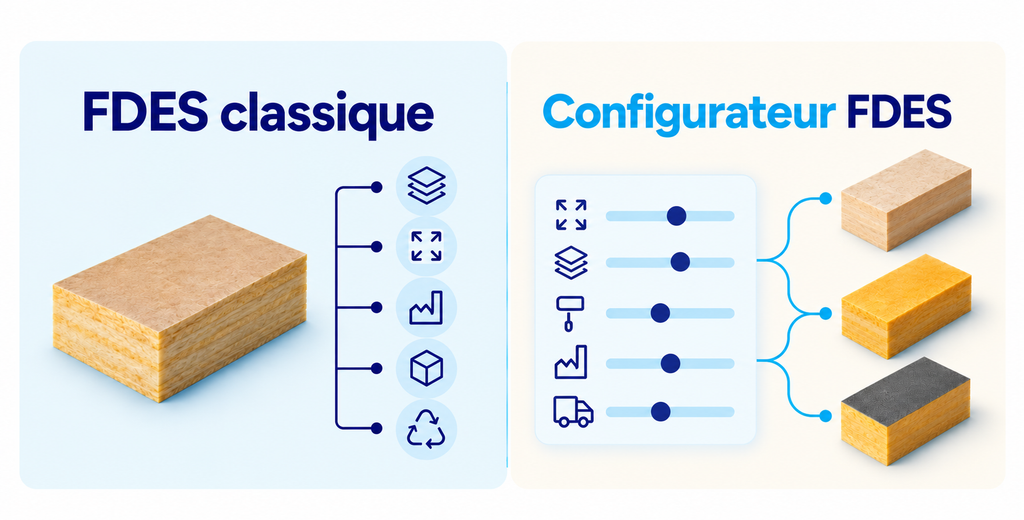
A change in dimensions can lead to an increase in the quantity of materials used. A change in composition can alter production flows. Changes to the product can also affect transport or end-of-life treatment.
The role of the configurator is precisely to account for this variability. Rather than simply providing the results of an LCA for a given product, it models the relationships between a product’s characteristics and its environmental impacts. Moving from a single FDES to a configurator therefore means moving from a static snapshot to a dynamic model.
How to choose the right parameters for an FDES configurator?
Given the diversity of products, it might be tempting to include as many parameters as possible in the configurator. However, this would be the wrong approach.
Not all product characteristics have the same influence on environmental impacts. Some can significantly affect LCA results, while others have only a marginal effect, or none at all. The first step in modelling is therefore to identify which parameters matter:
Which parameters actually influence the quantities of materials used?
Which changes in composition affect environmental impacts?
Which processes vary depending on the product configuration?
Which parameters can be considered constant?
And above all, what relationships exist between these different parameters?

This analysis makes it possible to build a model that is sufficiently accurate to reflect industrial reality without making it unnecessarily complex. The effectiveness of a configurator is therefore not measured by the number of parameters it offers users.
It is measured by the relevance of the parameters selected.
How does the modelling behind an FDES configurator work?
A configurator can be very easy to use while relying on a highly sophisticated environmental model. In fact, this is one of its main advantages: hiding some of the methodological complexity from the end user.
Software development is therefore just one stage of the project. Before writing a single line of code, it is essential to define the rules that will ensure the model remains consistent, regardless of the configuration generated.
Some relationships are relatively straightforward: an increase in dimensions can, for example, lead to a proportional increase in the quantities of materials used. Others are much more complex: a change in density can affect the quantity of raw materials required, as well as manufacturing parameters, transport and even certain end-of-life scenarios.
The modelling process involves understanding these interactions and translating them into robust calculation rules.
The software then applies these rules automatically.
What are the limitations of an FDES configurator?
Modelling the diversity of a product range does not mean attempting to cover every conceivable situation. A configurator operates within a clearly defined scope of validity:
A range of dimensions

A family of materials

A specific manufacturing process

Certain use scenarios
Outside this scope, the model can no longer guarantee that the results are representative. Defining these limits is therefore just as important as defining the parameters themselves. It helps ensure the scientific robustness of the approach while also facilitating the verification stages, particularly with a view to publication under the INIES programme.
How can data traceability be ensured
in an FDES configurator?
Automation is one of the main benefits of an FDES configurator. However, automating calculations does not mean making them a black box. Every FDES generated must be explainable and, above all, reproducible:

Selected parameters
Which product characteristics were entered?

Assumptions applied
Which methodological assumptions were applied?
Data used
Which data sources were used in the calculation?

Model version
Which version was in use at the time of the calculation?

Selected parameters
Which product characteristics were entered?
How are FDES configurators transforming the production of environmental data?
Beyond time savings and automation, configurators reflect a more fundamental shift. For a long time, environmental data were primarily produced in the form of documents describing a specific situation at a particular point in time.
With configurators, environmental data can now be structured into a model capable of generating information tailored to the product’s actual configuration.

Static document
Environmental data describe a specific situation at a particular point in time.

Structured model
The configurator generates information tailored to the product’s actual configuration.

Integrated digital data
Integration with design and specification tools, and business processes (BIM, etc.).
.
This shift reflects the digitalisation of the construction sector and growing expectations for more accurate environmental data. It also opens up new possibilities: integrating LCA data into business tools, connecting with design and specification software, automating certain processes and, more broadly, developing new forms of digital environmental data.
Why is LCA expertise essential for a reliable FDES configurator?
Behind every effective FDES configurator lies much more than a digital interface. There is an environmental model. And behind that model lies an in-depth understanding of the product, its manufacturing processes, data, parameters and the interactions between them. Developing an FDES configurator therefore requires a combination of several areas of expertise:
FDES fiable

Industrial
processes
Data
structuring
Life Cycle
Assessment

Digital
development

Modelling
At WeLOOP, we believe that the quality of a configurator depends first and foremost on the robustness of its methodological foundations. Our role is to transform an LCA into a structured, adaptable and verifiable model capable of representing the diversity of a product range while complying with the methodological requirements applicable to FDESs and the INIES programme. This expertise then provides the foundation for developing the digital tool.
A configurator therefore does not replace environmental expertise. It is its digital extension.
Meet us at MCV 2026: FDES configurators at the heart of the discussions
How do you turn an LCA model into a working configurator? Which parameters should be included? How should the calculation rules be structured? How can the traceability of results be ensured? And above all, how can a configurator become a genuinely valuable tool for manufacturers and their customers?
To answer these questions, WeLOOP invites you to join us at MCV 2026 for an event dedicated to configurators and their role in producing and sharing environmental data.
On the agenda: practical insights, methodological challenges, demonstrations and discussions on new ways of producing environmental data that accurately reflect the products actually manufactured.
Want to understand what goes on behind the scenes of an FDES configurator? More information about the event will be available soon. Register to join the discussions.