


Does decision-making require a consequential LCA?
Dieuwertje Schrijvers
Almost ten years ago, I defended my PhD on the topic of allocation in LCA. During my PhD research, I came across the terms "attributional LCA" and "consequential LCA", which appeared to be key determinants in choosing which allocation procedure to apply in cases of co-production or recycling in an LCA (see this blog specifically about allocation).
So, if I learned about these topics more than ten years ago, why dedicate this blog post to them? Well, there are two reasons.
Recently, I saw a visually attractive explainer on LinkedIn about the concepts of attributional and consequential LCA. Unfortunately, some statements were presented that I already opposed during my PhD research, and that are still persistent in the LCA community. Even so persistent, that the AI tool that I use uses these misconceptions in its generated text.
On top of that, I thought that the topics were clear to me, and that this was a closed case for me by now. However, there are still aspects of the concepts that confuse me and that I would like to explore further while writing this blog post (they say writing helps you think clearly, right?).
Therefore, I'm using this opportunity to get some clarity on these concepts as well (and hopefully not confuse you even further!).
What do we mean by “attributional” and “consequential” LCA?
First things first, what do we mean by these terms? Attributional and consequential LCA are LCA modelling approaches. They are lenses through which we look at a product system.
The terms were first introduced in a 2001 workshop on electricity modelling in LCA (Curran et al., 2005), where topics such as whether marginal or average data should be used and how co-product allocation must be applied were discussed.
At that time, they defined attributional and consequential LCA as follows:
|
Attributional LCA |
Consequential LCA |
|
|
Question to be answered |
Attributional LCIs attempt to answer ‘‘how are things (pollutants, resources, and exchanges among processes) flowing within the chosen temporal window?’’ |
Consequential LCIs attempt to answer ‘‘how will flows change in response to decisions?’’ |
|
Objective |
The attributional approach to LCI serves to allocate or attribute, to each product being produced in the economy at a given point in time, portions of the total pollution (and resource consumption flows) occurring from the economy as it is at a given point of time. |
The consequential approach to LCI attempts to estimate how flows to and from the environment will change as a result of different potential decisions. |
These definitions have been further refined in the UNEP/SETAC Life Cycle Initiative's Global Guidance Principles for Life Cycle Assessment Databases (Sonnemann and Vigon, 2011), which is nowadays considered a principal reference point in the scientific literature:
| Attributional LCA | Consequential LCA | |
| Definition | System modelling approach in which inputs and outputs are attributed to the functional unit of a product system by linking and/or partitioning the unit processes of the system according to a normative rule . | System modelling approach in which activities in a product system are linked so that activities are included in the product system to the extent that they are expected to change as a consequence of a change in demand for the functional unit. |
| Objective | The attributional approach attempts to provide information on what portion of global burdens can be associated with a product (and its life cycle). | The consequential approach attempts to provide information on the environmental burdens that occur, directly or indirectly, as a consequence of a decision (usually represented by changes in demand for a product). |
| Vision | In theory, if one were to conduct attributional LCAs of all final products, one would end up with the total observed environmental burdens worldwide. The systems analysed ideally contain processes that are actually directly linked by (physical, energy, and service) flows to the unit process that supplies the functional unit or reference flow. | In theory, the systems analysed in these LCAs are made up only of processes that are actually affected by the decision, that is, that change their output due to a signal they receive from a cause-and-effect chain whose origin is a particular decision. |
| Also called | "Accounting" or "descriptive approach" | "Change-oriented approach" |
| Data used | Uses data on actual suppliers or average data | Uses data on actual supplier as long as this supplier is not constrained (i.e., insofar as it can respond to an increase in demand with an equal increase in supply), otherwise uses data representing marginal technology (i.e., suppliers that will actually respond to a change in demand) |
| Multifunctionality modelling | Commonly uses allocation as a means to deal with multifunctional processes or systems. | Uses a system expansion approach to deal with multifunctional processes to expand the analysed system with additional processes. |
As you can see from the UNEP/SETAC definitions and guidance, attributional and consequential LCAs put divergent requirements on how to build up your LCA model: the type of data to choose (average data versus data representing marginal, unconstrained suppliers), and how to model co-production and recycling (allocation versus system expansion (here: substitution)).
Whether you conduct an attributional or consequential LCA is therefore a choice every LCA practitioner makes, consciously or subconsciously, and should ideally communicate transparently.
When should we apply either approach in practice?
So, concretely, when would you apply either approach? Generally, I introduce the concepts of attributional or consequential LCA as depicted in Figure 1.
When we want to assess the impacts of a product, take, for example, recycled polypropylene (PP), we can assess these impacts with different motivations. First, we may be interested in environmental impacts because we don't want to be associated with them. We don't want to feel guilty, we want to protect our (or our company's) image, we want to avoid having to pay environmental taxes, or we may anticipate environmental regulations.
We can formulate our research question more precisely by asking
For what environmental impacts is the user of 1 kg of recycled PP accountable?
On the other hand, we may be interested in the global status of the ecosphere. We want to ensure that our actions do not harm the ecosphere, and, ideally, reduce mankind's impacts on it. In other words, we want to make a difference for the planet.
We can formulate our research question more precisely as :
What environmental impacts are caused by the user of 1 kg of recycled PP
For the first question, I would conduct an attributional LCA; for the second, a consequential LCA.
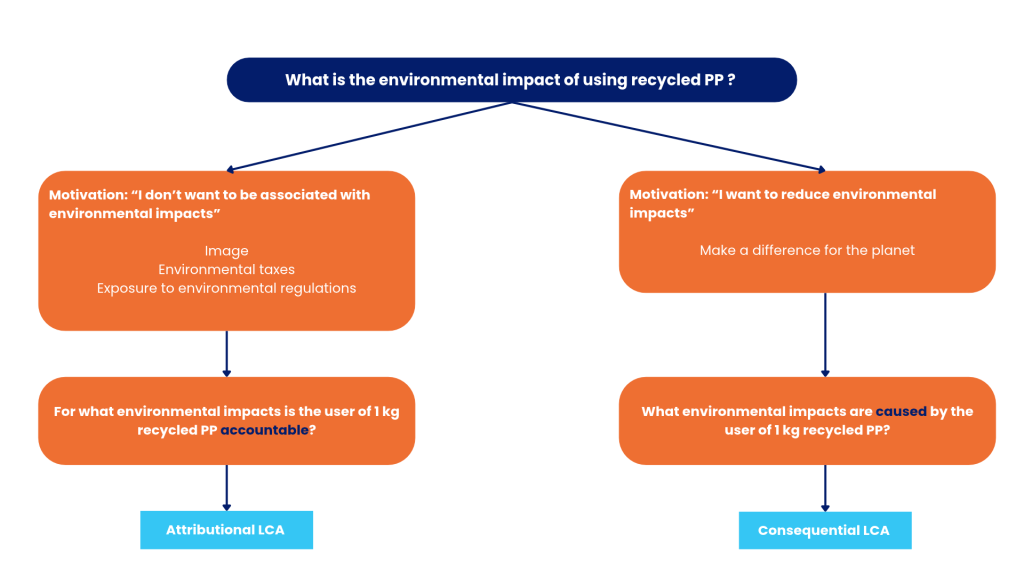
Figure 1 Selecting an attributional or consequential LCA approach based on the motivation to conduct an LCA.
In a 2020 paper of mine, I refer to this distinction as "the perspective of the LCA". However, as "perspective of the LCA" is too broad a term (as perspective can also refer to other aspects of the LCA, e.g. in relation to time, or system boundaries).
Nowadays, I prefer to refer to this as the "impact scope" of the LCA, which also aligns well with the graphical representation of attributional and consequential LCA in the UNEP/SETAC Guidance document in Figure 2.
From this, stating that an LCA study assesses "the environmental impact of a product" is not sufficient to make important modelling choices; the Goal and Scope definition of the LCA must specify which impact scope is applied in the study.
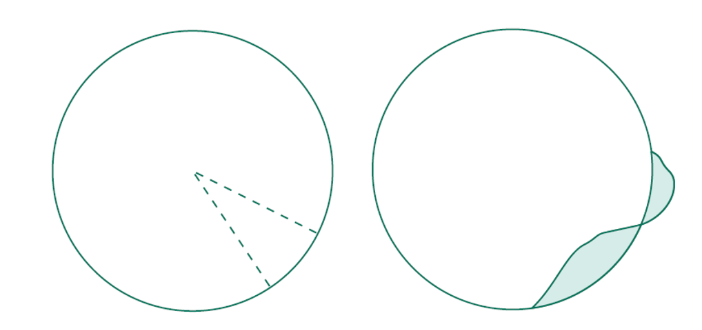
Figure 2. Différences conceptuelles entre l’ACV attributionnelle (à gauche) et l’ACV conséquentielle (à droite). Chaque cercle représente l’ensemble des pressions environnementales à un instant donné. L’ACV attributionnelle évalue la part de ces pressions pouvant être attribuée à un produit, tandis que l’ACV conséquentielle évalue l’évolution des pressions environnementales totales à la suite d’une modification de la demande d’un produit (Sonnemann et Vigon, (2011), d’après Weidema,( 2003)).
A persistent misconception about consequential LCA
Now, you may be wondering, what did I see on LinkedIn, and what did my AI tool say, that bothered me so much that I wanted to write a blog post about this? Both sources claimed that consequential LCA should be used in decision-making contexts, and this is where I disagree.
I think this idea has taken hold in the LCA community because both Curran et al. and the UNEP/SETAC Guidance use the word "decision" to describe consequential LCA. The ILCD Handbook adds that meso- and macro-level decision-making requires a consequential LCA.
In principle, that applies to micro-level decisions too, but the Handbook recommends attributional modelling there to keep things simple.
I think that a consequential LCA can be very relevant to support decision-making regarding the following questions:
- Should I eat less meat…
- Should I take the train instead of the plane…
- Should I buy a reusable water bottle or a plastic bottle…
- Should we move towards electric mobility…
..in order to save the planet?
An attributional LCA would be more suitable if I formulated the following questions:
- Should I eat less meat…
- Should I take the train instead of the plane…
- Should I buy a reusable water bottle or a plastic bottle…
- Should we move towards electric mobility…
…in order to be less accountable for environmental impacts?
Did you notice that it's not the fact that I want to take a decision, or even that I anticipate a change, nor the size of this change, that determines whether I should do an attributional or a consequential LCA?
Only the scope of the impacts I am interested in makes the difference.
Even stating that "I want to assess the consequences of a change" would not automatically require a consequential LCA.
The consequences on what? On the planet? Or on my reputation? On the impacts for which I can be held accountable? Again, it is the impact scope.
How should we interpret “accountability for impacts”?
If we agree to conduct an attributional LCA to assess which impacts a product is accountable for, how do we define "accountability for impacts"? There is no objective rule that decides this. Therefore, the UNEP/SETAC Guidance defines attributional LCA as follows: "inputs and outputs are attributed to the functional unit of a product system by linking and/or partitioning the unit processes of the system according to a normative rule" (emphasis added by me). In other words, a rule must be formulated that states what is understood by "accountability for impacts".
This rule cannot be proven; it can only be agreed upon, and it forms the foundation of the LCA model in a specific study. Therefore, this rule can be understood as an "axiom", which I further explored in a paper in 2021. An example of such an axiom is that :
"The environmental impacts of a process should be allocated to its co-products based on the relative economic revenue they generate, because the economic revenue generated by the process is the reason that the process exists in the first place".
People who agree with this rule also agree with applying economic partitioning in co-production situations.
Different stakeholder groups can come together and agree on what they mean by "accountability for impacts". This could result in different modelling approaches, such as partitioning by mass, exergy, calorific content, or by economic value (see, for example, Pelletier et al. (2014)). LCA results following this specific modelling approach will then, sometimes exclusively, be accepted by the normative requirements of the defined stakeholder group. It is also understandable that we can have different modelling requirements in different reporting contexts (such as EN 15804, PEF, etc.; see also Schrijvers et al. (2026)).
To me, formulating axioms, or normative rules, was a solid approach to developing a consistent attributional methodology. However, there is one caveat that I also mentioned in my paper:
"A different understanding of the attributability of impacts could lead to a different partitioning criterion or even require a consequential LCA."
Take, for example, Weidema et al. (2018). They argue that a product (or the user or producer of a product) must be held accountable for the impacts generated as a consequence of producing this product, i.e. the consequential impact scope.
Does that mean that a consequential LCA can be considered a sub-category of attributional LCA? That we can conduct a consequential LCA to assess one's accountability for impacts?
Technically, we could argue that a consequential LCA is also an approach for "attributing impacts to products", albeit the impacts that are caused by the production of those products.
I know that it does not fit the vision for an attributional LCA as formulated by the UNEP/SETAC Guidance – that "The systems analysed ideally contain processes that are actually directly linked by (physical, energy, and service) flows to the unit process that supplies the functional unit or reference flow."
But still, doesn't this condition feel rather artificial in the wish to separate attributional from consequential LCA?
Combine different angles to achieve environmental benefits
I like the distinction of systems as introduced by Weidema et al (2018) to track different types of "responsibility for impact" (rephrased in my own words):
- supply chains (the flows you use),
- value chains (the flows you pay for),
- the consequential system (the flows that are induced by your action)
Weidema et al. demonstrate that looking at a product system from different angles gives the best chance of achieving environmental benefits, as Ekvall et al. (2005) also nicely formulated.
Looking at a product system from different angles is, however, not the same as combining different modelling methods in a single LCA study.
I think that mixing up different modelling methods is often due to two reasons:
- some modelling methods are considered easier to apply (such as using average instead of marginal data, or the modelling of substitution rather than economic partitioning), and
- the rationale of different normative rules may be considered relevant by the same (group of) LCA practitioner(s), resulting in a mixing and matching of modelling approaches.
A disadvantage of mixing attributional and consequential models is that it becomes unclear which "impact scope" is applied; hence, how the impacts should be interpreted. Is a lower footprint also beneficial for the ecosystem? Or only for someone's portfolio?
Is a lower footprint also beneficial for the ecosystem? Or only for someone's portfolio?
A promising step in the right direction is a multi-statement reporting structure, currently under discussion under the GHG Protocol framework. This approach would involve reporting physical,marlket-based,and consequentiel inventories alongside one another.
Attributional LCA… Quo vadis?
So how should we now interpret the term "attributional LCA", if consequential LCA is also an approach to "attribute impacts to products according to a normative rule"?
The concepts of the supply chain, the value chain, and the consequential system already provide guidance on selecting background data. For the modelling of multifunctionality, perhaps we should steer away from defining attributional LCA as "...attributing impacts to the functional unit..." towards "...allocating impacts according to a product's attribute, such as its economic value, mass, exergy, or other relevant property".
So we can still use the same vocabulary of which we have grown fond by now.
Further reading
Do you want to read more about this topic? Here are the references I used in this article:
You can also explore our dedicated training course on allocation methods in Life Cycle Assessment (LCA) to deepen your knowledge and better understand how to apply them in your environmental studies.
Need support with your life cycle assessment?
Choosing the right LCA approach is essential to obtaining relevant and reliable environmental results. Discover how WeLOOP can support you in conducting your LCA studies.