


EF 4.0 and BAFU: towards a common foundation for LCA data?
Naeem Adibi & Emilie Guilvert
More accessible data. Greater transparency. A shared foundation for environmental decisions. The ambition behind Europe’s next Environmental Footprint database remains compelling. The European Commission’s workshop on 22 September 2026 brought that ambition into sharper focus, and exposed the choices that will determine whether it delivers.
In our previous article on EF 4.0, we explored how a free, machine-readable database could transform life cycle assessment (LCA). The latest presentations and discussion provide an important update: the development timetable is evolving, the access model remains unsettled, and cooperation with existing databases is gaining substance.
For businesses, the opportunity is significant: environmental data that are easier to access, understand and integrate into decisions. Realising that opportunity will require clear rules, reliable models and sustained investment in quality.
When will the new EF database be ready?
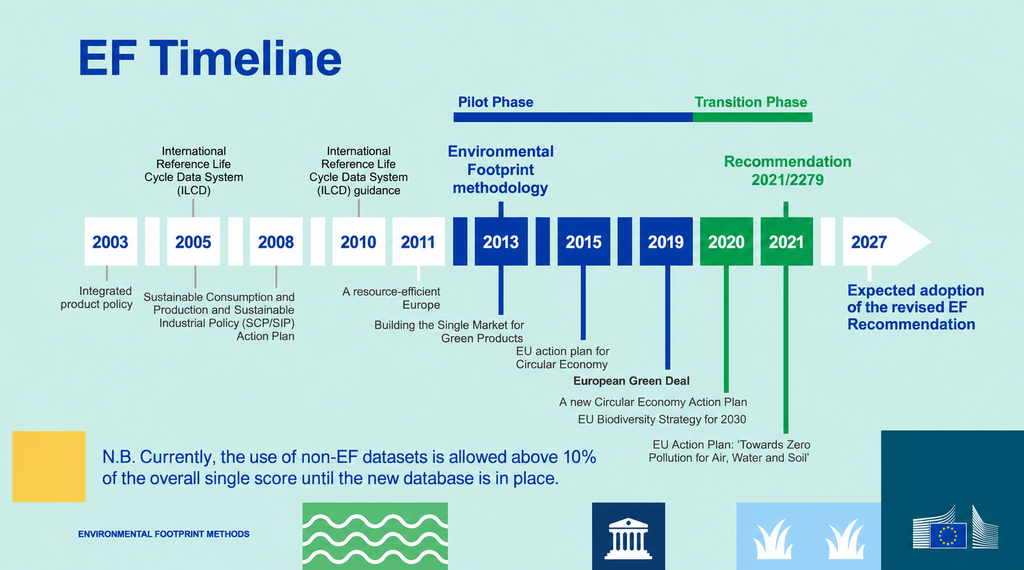
The workshop expects the revised EF recommendation in 2027 . The method and its supporting database have distinct timelines: this is a key update to the outlook presented in our earlier article.
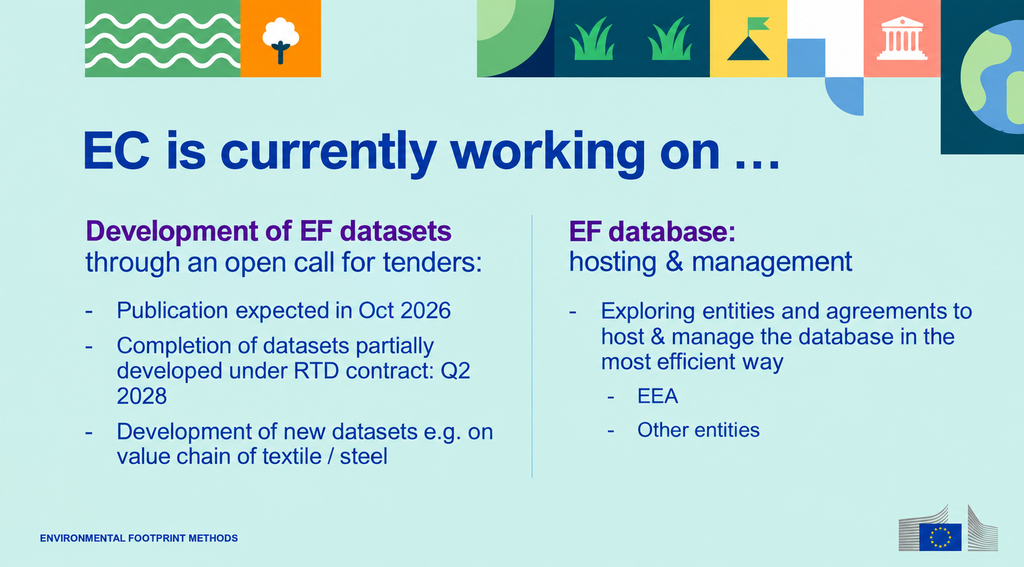
The Commission expects to publish a new call for tenders in October 2026. Its purpose is to complete datasets partially developed under a previous DG Research and Innovation contract, which the Commission explained had ended early for administrative reasons, and to develop additional datasets.
The Commission targets Q2 of 2028 to complete the previously started datasets. During the discussion, the Commission also said it expects the datasets covered by the forthcoming tender, to be completed by mid-2028. Core areas include energy, transport, packaging, end-of-life processes, chemicals and metals; textiles and steel were among the examples of further development discussed.
Hosting, management and the IT platform are being explored alongside this work. These expectations should therefore be understood as development targets, rather than a guaranteed launch date for a fully operational database covering every sector.
Will EF 4.0 data be freely accessible and reusable?
One oral clarification deserves particular attention. The Commission described its objective as open access. The workshop did not, however, establish the final access and licensing arrangements.
That qualifies the prospect of a fully free database discussed in our previous article. Affordability and accessibility are clear priorities, especially for companies using environmental data to demonstrate compliance.
For software developers and businesses building product configurators, the practical questions extend to use of the data: what can be embedded in a tool, adapted, shared with customers or maintained over time? Clear answers will be essential to support inclusion in digital LCA services.
What role can BAFU play during the transition and beyond?
The Swiss Federal Administration’s BAFU database was presented as a working example of an open-access life cycle inventory infrastructure. BAFU reported 11,747 inventories, with a Swiss focus and opportunities to broaden coverage through international cooperation.
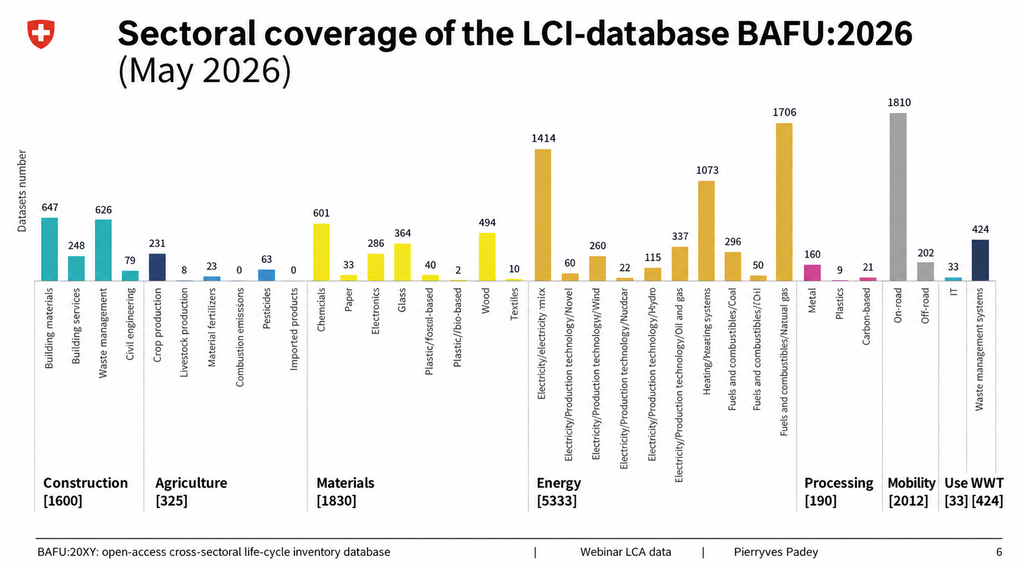
The discussion established an immediate connection with EF. The Commission explicitly identified BAFU as a database that, in its assessment, meets the requirements of the interim guidance for applying EF methods while the new EF database is unavailable. It also confirmed that practitioners retain a choice of database during this period: BAFU is an option, not a mandatory selection.
Beware, this does not make every BAFU dataset automatically suitable for every product or geography. Representativeness, modelling choices and consistency are still required, following PEF methodology. The Commission also expressed interest in future cooperation with BAFU. Meanwhile, the Partnership for Life Cycle Data presented Probas database to adapt thousands of Swiss datasets to German conditions and develop additional German datasets for the coming 3 years.
A shared data foundation is now becoming a practical possibility. Its value will depend on how carefully the data is adapted and connected.
How can transparency and industrial confidentiality work together?
The case for greater transparency was strong throughout the workshop. Practitioners need to understand the assumptions behind a result, inspect background processes and assess whether a dataset fits their study.
Detailed industrial data can reveal commercially sensitive information, including elements of production costs. Participants expressed different views on how far public disclosure should go and how to protect confidentiality.
Several approaches were discussed: representative averages across producers, fuller access for independent reviewers, and sufficient visibility of modelling rules to support quality and company-specific modelling. No final EF approach was established during this consultation.
For WeLOOP, the practical requirement is that users can understand the model and reviewers can examine the evidence needed to assess its reliability. The architecture of the data must make those responsibilities explicit.
Can industry data become reliable LCA datasets?
A particularly useful discussion concerned how industry should contribute. Should companies supply raw data, or complete, verified LCA datasets?
Raw-data submission could lower barriers for companies without specialist modelling capabilities. Expert support could then help turn those inputs into consistent inventories. Other participants stressed that dataset creation requires dialogue with industry about representativeness, process boundaries, allocation and modelling choices.
A submission platform or dataset editor could facilitate this work. But it could not, by itself, resolve the methodological questions behind the numbers.
The potential role of artificial intelligence also remains an open question. The Commission invited views on whether and how AI could support data submission, review and database management. These possibilities warrant further exploration to understand where AI might add value and what safeguards would be needed to preserve data provenance, quality and accountability.
What will It take to ensure data quality and independent verification?
One of the strongest messages from the discussion was the need for independent verification. Developing more datasets will create limited value if their reliability is not adequately checked.
Participants highlighted the need for reviewers who combine LCA expertise with knowledge of the industrial processes concerned. It would complement the assurance given by data quality ratings.
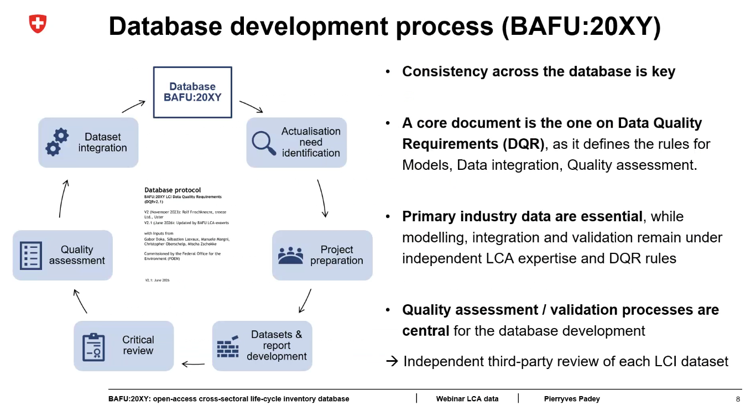
BAFU’s presentation offered a concrete governance example: public authorities define the framework; industry contributes primary data and technical knowledge; LCA experts develop consistent models; independent reviewers assess the work. BAFU publishes its review reports alongside the supporting documentation. Credibility requires investment in verification as well as data production.
How can data, methods and international initiatives stay aligned?
Participants raised a further challenge: developing datasets while methodological revisions are still under discussion. Biogenic carbon was one example where alignment between accounting conventions and database models matters. International standardisation work adds another reason to coordinate decisions carefully.
Maintenance creates a related tension. Databases need to reflect technological change, while policy applications need sufficient stability for companies to interpret thresholds and track progress. Clear versions, documented updates and reproducible calculations will be critical.
Contributors also called for closer connections with national initiatives and the Global LCA Atlas. The Commission acknowledged the importance of avoiding duplicated effort, while emphasizing its immediate responsibility to support European policy implementation.
How can businesses prepare for the next generation of LCA data?
Companies can prepare by documenting the datasets and versions behind their current studies, strengthening primary-data collection and identifying where background assumptions materially influence results. Digital tools should then accommodate database updates while preserving the traceability of earlier calculations.
Businesses can also reply to the call for tenders planned for October 2026 to complete datasets partially developed and develop new ones for the steel or textile industry for instance.
At WeLOOP, we see a substantial opportunity for more accessible data to broaden LCA use and accelerate ecodesign.
EF 4.0 will earn trust through the decisions its data can support. The work to build that trust is now taking shape.
From research to shared LCA data: what is WeLOOP contributing?
At WeLOOP, we actively contribute to the development of life cycle inventory (LCI) data through research projects and industry collaboration. Our involvement in European-funded projects, including BIOARC, Bio4HUMAN, CALIMERO, CEDaCI, AQUALICIOUS, and MOXY, supports data collection and environmental modelling across sectors ranging from bio-based materials and aquaculture to digital equipment and cultural heritage conservation. We see European research projects as a rich source of primary data that could help expand the future EF 4.0 database, subject to methodological alignment, independent verification and appropriate reuse rights.
In the battery sector, our BATTERS database provides detailed inventories for recycling processes and recycled materials, complemented by ongoing work on battery-cell manufacturing inventories. We also contribute to environmental data for electrical and electronic equipment through naKnow, supported by the France 2030 ECONUM programme managed by ADEME, combining component characterisation, laboratory evidence and modelling. Our ambition is to turn project-level knowledge into reliable, reusable data that can strengthen the shared foundations of LCA.